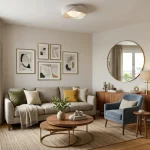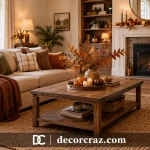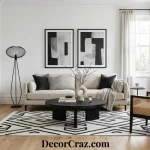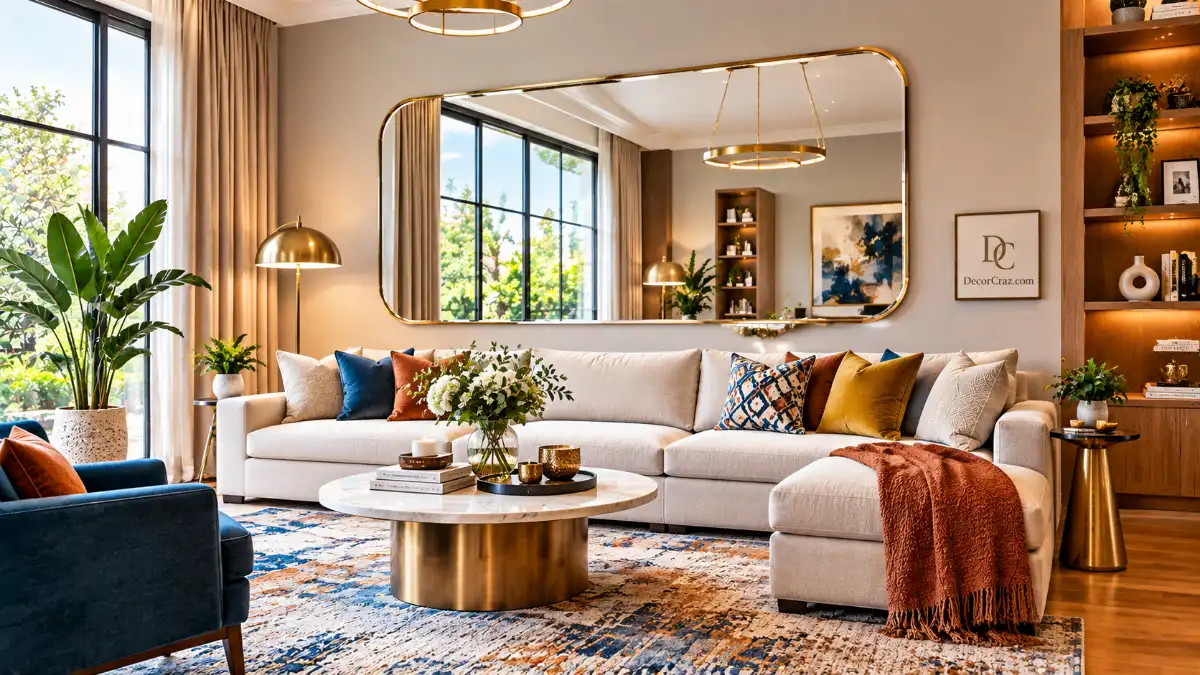
Mirror wall decor for living room spaces can do more than fill an empty wall. The right mirror can become a focal point, reflect natural light, soften strong furniture lines, or make a compact room feel more visually open.
The challenge is choosing a mirror that fits the wall, relates to nearby furniture, and reflects something worth seeing. Before buying one, consider three things: where the mirror will go, what it will reflect, and how its size and frame relate to the room.
A large mirror above a sofa creates a different effect from a small gallery of decorative mirrors or a round mirror above a console.
The ideas below focus on practical living room applications, from statement mirrors and arched shapes to gallery walls, fireplace arrangements, small spaces, and light enhancing placement.
Hang an Oversized Mirror Above the Sofa
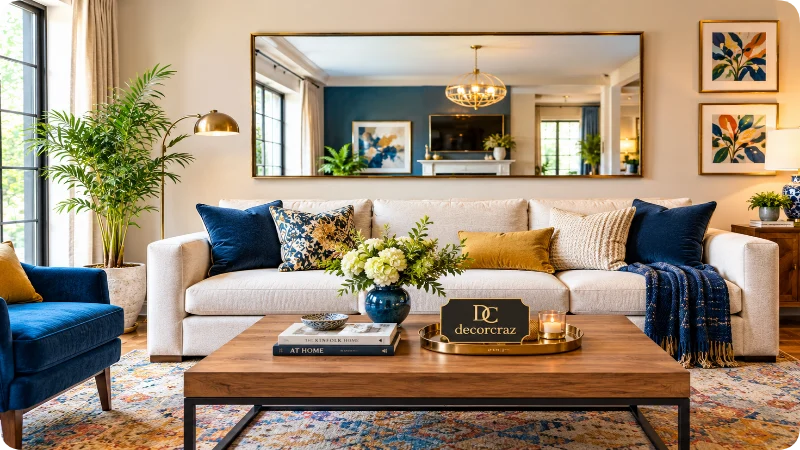
An oversized mirror can provide a strong focal point on a large wall behind the sofa. Instead of filling the space with numerous small decorations, one substantial mirror gives the seating area a clear visual anchor.
The important part is proportion. A mirror that is too small can look disconnected from a large sofa, while one that is excessively wide can overpower the furniture.
Match the Mirror to the Sofa
Use the sofa as your primary reference point. A mirror around two thirds to three quarters of the sofa’s width is a useful starting point, but wall width, frame thickness, ceiling height, and surrounding decor can change the ideal proportion. Current design guidance commonly uses this range as a starting point rather than a strict rule.
A horizontal rectangular mirror works naturally with a long sofa because both elements share a horizontal direction. A large round or arched mirror can create more contrast.
Keep the Composition Connected
Leave a modest visual gap between the sofa back and mirror rather than placing the mirror immediately above the upholstery. Several current guides use roughly 6–12 inches as a starting range, but the exact distance should be adjusted to the furniture and mirror size.
Before drilling, tape a paper outline of the proposed mirror onto the wall and view it from the main seating positions.
Choose an Arched Mirror to Soften Straight Lines
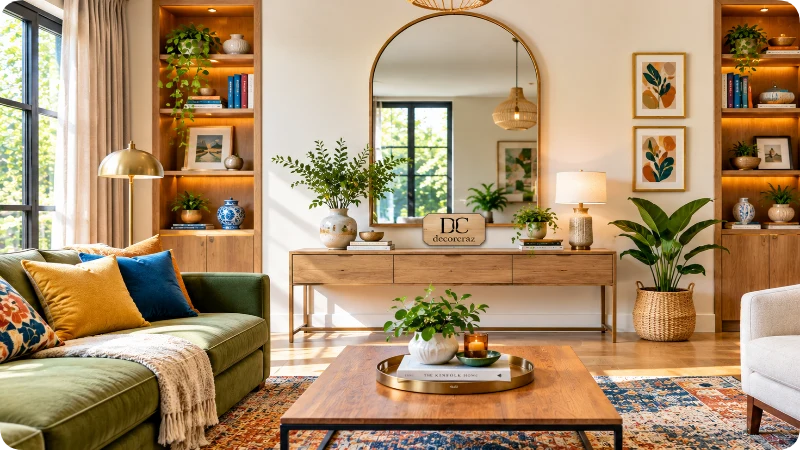
An arched mirror can introduce a softer shape into a living room filled with rectangular furniture, shelves, windows, and cabinets.
This shape works particularly well in contemporary, transitional, organic modern, and minimalist interiors because it provides visual contrast without requiring a heavily decorative frame.
Use the Arch as the Main Shape
If you choose a large arched mirror, allow it to stand on its own rather than surrounding it with too many competing wall decorations. The curved top already provides architectural interest.
A thin black frame creates a crisp modern effect. Natural wood gives the mirror a warmer appearance, while brass or bronze can work in a more refined setting.
Consider Ceiling Height
An arched mirror draws the eye upward, which can be useful on a wall with generous vertical space. In a room with a lower ceiling, choose a proportion that leaves enough breathing room above the mirror rather than forcing an extremely tall design into the wall.
The goal is to make the shape feel intentional in relation to the entire wall.
Use a Round Mirror Above a Console Table
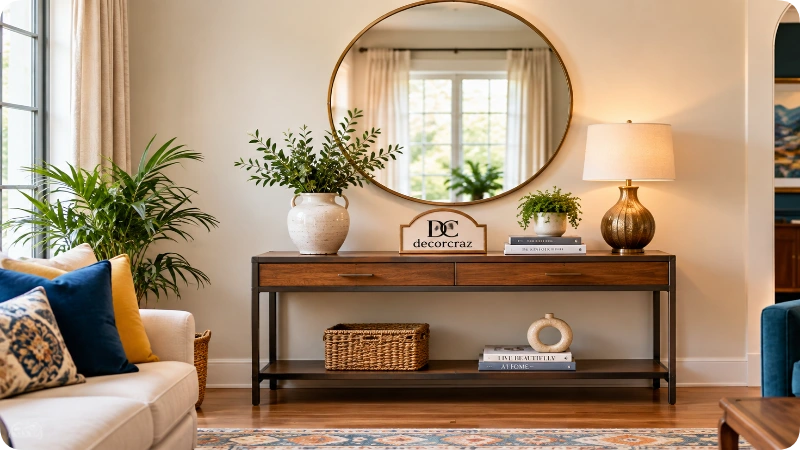
A round mirror above a console creates an easy living room vignette because the rectangular furniture and circular mirror naturally contrast with one another.
Start by centering the mirror with the console. Then keep the objects on the console relatively simple so the mirror remains the main feature.
Build Around the Mirror
A table lamp, ceramic vase, small plant, books, or sculptural object can support the arrangement. Avoid placing tall objects directly in front of the mirror because they can block too much of its reflective surface.
Coordinate the Frame
The frame does not have to match the console exactly. Instead, connect it to another finish in the room. For example, a black mirror frame can echo black lighting fixtures, while brass can connect with hardware or decorative accents.
This creates cohesion without making the room look overly matched.
A console also provides a practical advantage: it visually grounds the mirror and prevents a large piece from appearing to float on an empty wall.
Create a Decorative Mirror Gallery Wall
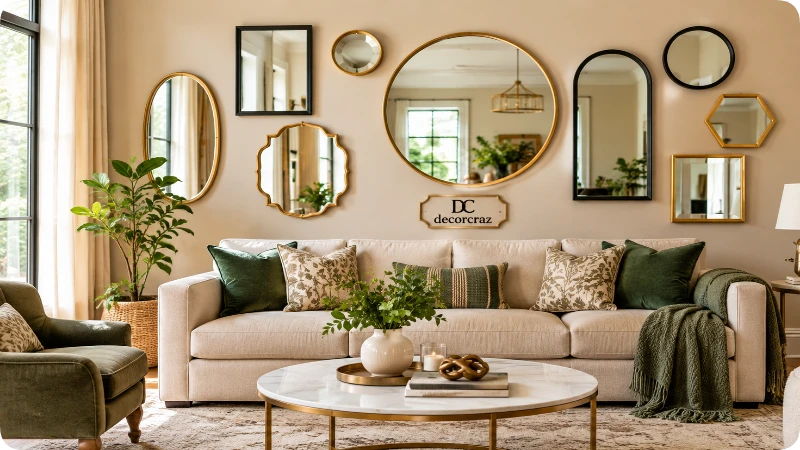
A mirror gallery wall can work when one mirror feels too simple but a traditional artwork gallery does not fit your decorating style.
The strongest arrangements have some consistency even when the individual mirrors differ.
Mix Shapes With a Common Detail
You can combine round, oval, rectangular, and geometric mirrors. To prevent the arrangement from looking random, repeat one characteristic such as:
- Similar frame colors
- Related metallic finishes
- A consistent color palette
- Repeated circular or curved shapes
- Similar frame thickness
You do not need every mirror to match.
Plan the Arrangement Before Hanging
Lay the mirrors on the floor and experiment with spacing. You can also create paper templates and temporarily tape them to the wall before installing hardware.
This is especially useful because a mirror gallery wall creates multiple reflection points. A layout that looks balanced from one angle may look crowded from another.
Current mirror guides similarly recommend testing groupings before making permanent wall holes.
Place a Statement Mirror Above the Fireplace
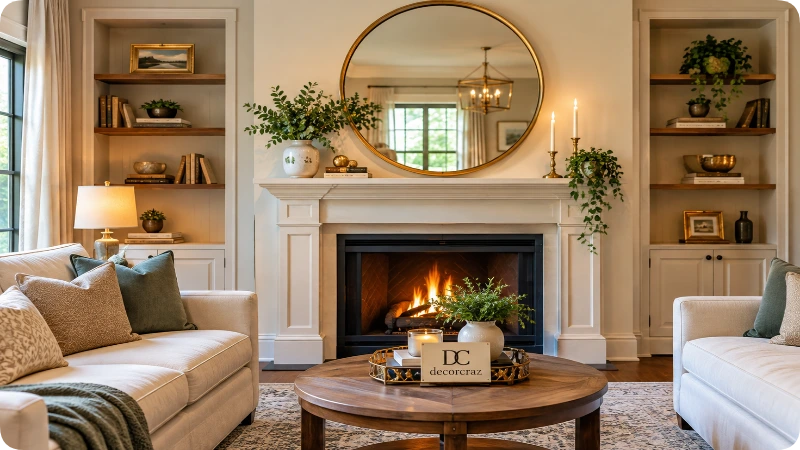
A fireplace already acts as a focal point, so the mirror above it should complement rather than compete with the architecture.
A large round mirror can soften a traditional rectangular mantel, while a rectangular or arched mirror can reinforce a more structured fireplace design.
Match the Mirror to the Mantel
Look at the width and visual weight of the fireplace. A tiny mirror can disappear above a substantial mantel, while an excessively large one can make the fireplace feel crowded.
The frame should also relate to the room. Ornate gold works in a traditional or glam setting, while simple black, bronze, or wood can suit modern and transitional interiors.
Check the Reflection From the Sofa
Do not judge the mirror only while standing directly in front of it. Sit on the sofa and look at what appears in the glass.
If the mirror reflects clutter, a television, harsh lighting, or an unattractive corner, repositioning it may improve the entire composition. Reflection quality is one of the most important considerations when deciding where a living room mirror belongs.
If the fireplace is functional, follow the fireplace and mirror manufacturer’s installation and clearance guidance rather than assuming a decorative placement is automatically safe.
Use a Black Framed Mirror for Modern Contrast
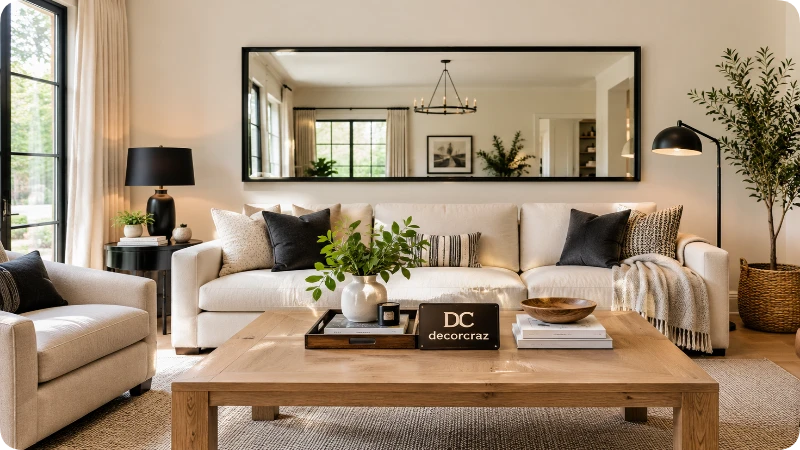
A black framed mirror can create a crisp architectural accent, particularly against white, cream, beige, or softly colored walls.
The effect is especially cohesive when the room already has black details such as lighting, window frames, furniture legs, artwork frames, or hardware.
Choose the Frame Weight Carefully
A slim black frame gives a subtle outline around the reflective surface. A thick frame becomes a stronger decorative element and can make the mirror appear visually heavier.
If the room already contains several dark accents, a thinner frame may be enough. If the furniture is pale and the wall feels visually empty, a more substantial black frame can provide useful contrast.
Pair It With Softer Textures
Black metal or dark wood can feel severe if every other element is equally hard and angular. Balance it with upholstery, linen, wood, plants, woven materials, or rounded furniture.
This keeps the mirror connected to the room rather than making it look like an isolated black rectangle.
Choose a Vintage or Ornate Mirror for Character
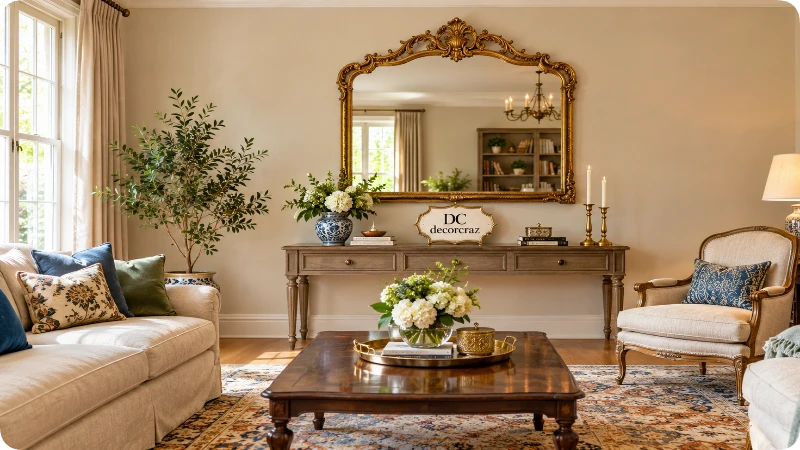
A vintage inspired mirror can add decorative personality to a living room that otherwise feels too plain.
Antique gold, aged bronze, carved wood, distressed finishes, and sculptural frames can work particularly well in traditional, transitional, vintage, and eclectic rooms.
Let the Frame Do the Decorating
An ornate mirror already contains substantial visual detail. Surrounding it with too many decorative objects can make the wall feel crowded.
Instead, give the mirror enough empty space to function as the focal point.
Mix Old Looking and Modern Pieces
A vintage style mirror does not require an entirely traditional room. In fact, placing an ornate mirror above a streamlined console or pairing it with contemporary furniture can create useful contrast.
If you want a collected look, repeat one finish from the mirror somewhere else in the room rather than matching every item.
Position a Mirror to Reflect Natural Light
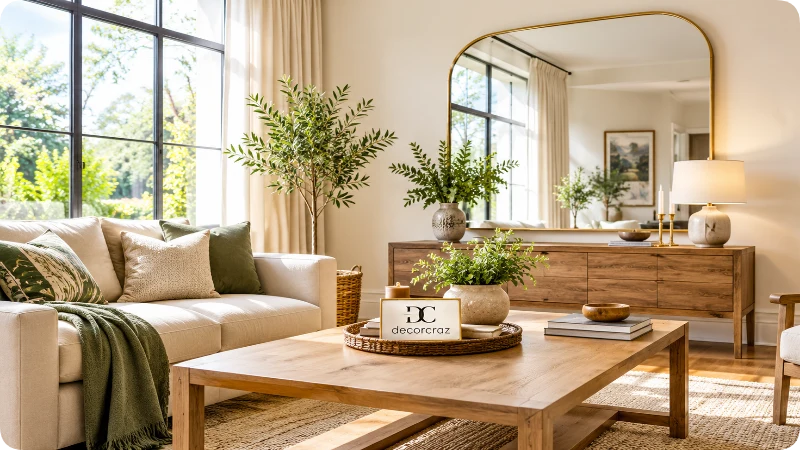
Mirrors can reflect daylight and create a greater sense of visual depth, but placement matters more than simply buying a large mirror.
A mirror near or opposite a window can capture light and reflect it into another part of the room. However, direct sunlight can also create glare depending on the angle.
Look at the Reflection Before Installing
Stand where the mirror will be placed and look toward the area it will reflect.
A desirable reflection might include:
- A bright window
- Greenery
- Artwork
- An attractive architectural feature
- Open space
- A well styled seating area
An undesirable reflection could include:
- Clutter
- Cables
- A messy shelf
- A television
- Harsh lighting
- A frequently used doorway
The mirror effectively repeats whatever it sees, so the reflected view should be treated as part of the design. Current living room mirror guidance consistently emphasizes checking reflections before final placement.
Combine a Mirror With Artwork
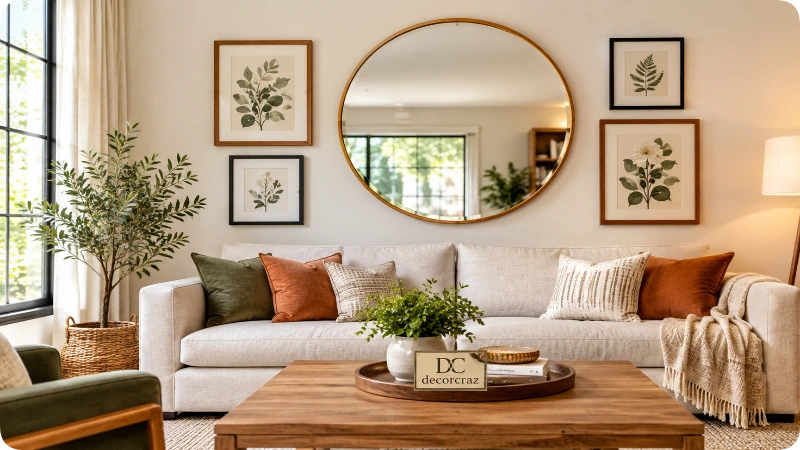
If a single mirror feels too plain and a full mirror gallery feels excessive, combine one mirror with artwork.
Start with the mirror as the anchor. Then place smaller framed artwork around it while maintaining a consistent visual relationship.
Repeat Frames or Colors
A black framed mirror can work with black framed botanical prints. A brass mirror can pair with warm toned artwork. A natural wood mirror can connect with landscape prints and woven textures.
The artwork should support the mirror rather than compete with its reflection.
Leave Breathing Room
Do not fill every available section of wall. The reflective surface needs enough surrounding space to remain visually important.
This approach is especially useful for homeowners who want the personality of a gallery wall while still retaining the functional and light reflecting qualities of a mirror. Mixing mirrors with artwork is also a commonly suggested way to create a more personal wall composition.
Try an Organic Shaped Mirror
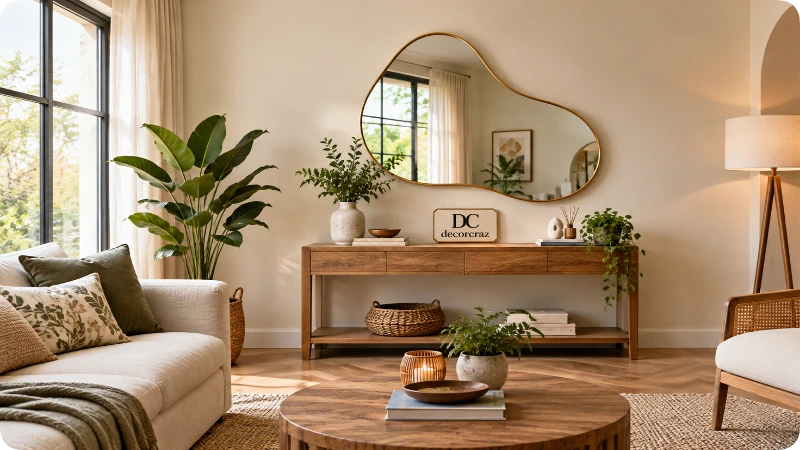
An irregular or organic shaped mirror can function almost like sculptural wall art.
Instead of relying on a conventional rectangle or circle, choose a shape with gentle curves or an asymmetrical outline. This can work particularly well in organic modern, contemporary, and eclectic living rooms.
Keep the Surroundings Simple
An unusual mirror already has a strong silhouette. Give it enough negative space so the shape remains easy to see.
Pair it with natural materials such as wood, stone, linen, rattan, or greenery if you want an organic appearance.
Use Contrast Intentionally
A soft organic mirror against a straight lined sofa or console can create a balanced contrast. The surrounding furniture does not need to have curved edges as long as the overall composition feels connected.
This is a useful choice when you want wall decor that feels more artistic without creating a full gallery wall.
Use Two Matching Mirrors for a Balanced Wall
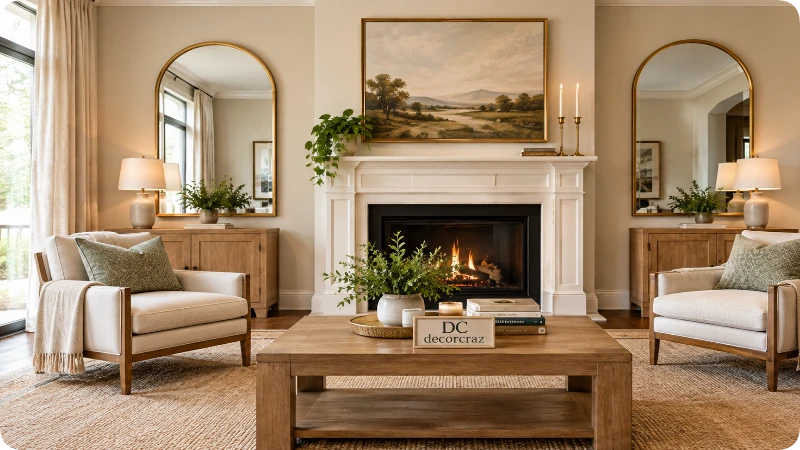
Two mirrors can create symmetry on a wide living room wall, especially when the wall contains a pair of chairs, two consoles, or another naturally balanced arrangement.
Matching mirrors make the room feel more organized than a collection of unrelated decorative pieces.
Align Them With the Furniture
If two chairs sit on either side of a central feature, place a mirror above each chair or use the furniture arrangement as the reference for spacing.
Keep the frames consistent so the pair reads as one composition.
Avoid Overcrowding
Two large mirrors can create a lot of reflection. If the room already has shiny surfaces, glass tables, or metallic furniture, choose simpler frames and avoid adding too many additional reflective objects.
This arrangement works particularly well in formal, traditional, transitional, and symmetrical living rooms.
Use a Large Mirror to Open Up a Small Living Room
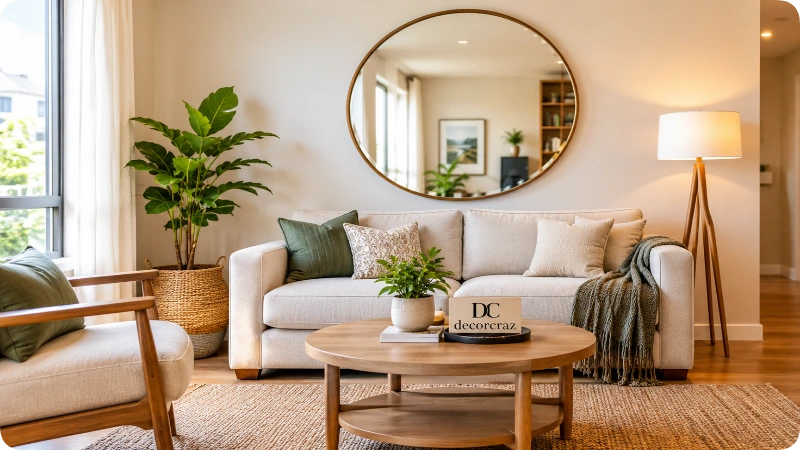
A small living room does not necessarily need several tiny mirrors. One appropriately scaled mirror can provide a cleaner result.
Place it where it can reflect daylight or an open portion of the room. A round, oval, or softly arched shape can also break up the visual density of furniture.
Choose One Strong Focal Point
If the room is already compact, avoid covering every wall with reflective decor. One large mirror can provide the intended visual effect without creating multiple competing reflections.
Keep the Frame Visually Light
A thin frame can maintain an open appearance. A very heavy frame may make a small room feel more visually crowded.
The mirror should also remain proportional to nearby furniture. The objective is not to make the mirror as large as possible; it is to choose a size that feels substantial without overwhelming the room.
How to Choose the Right Mirror Size for Your Living Room
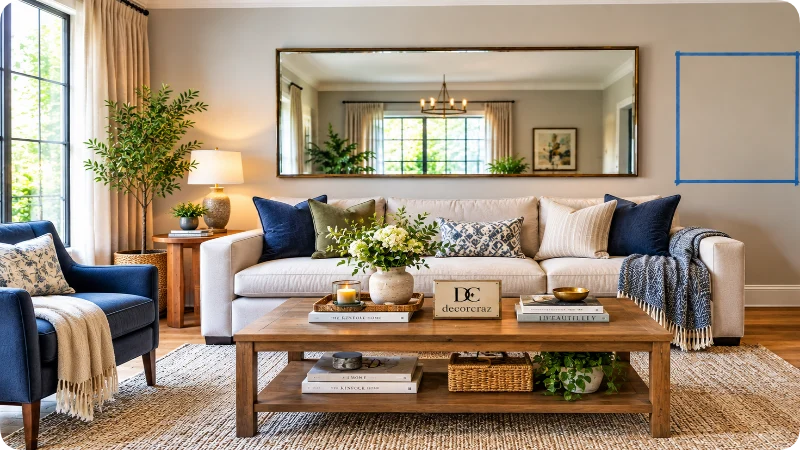
Mirror size should be determined by the wall and furniture around it rather than by the mirror alone.
For a mirror above a sofa or console, compare its width with the furniture beneath it. A commonly used starting point is approximately two thirds to three quarters of the furniture’s width, although this is a design guideline rather than a strict measurement.
For example, if your sofa is 84 inches wide, a mirror around 56–63 inches wide could be a useful starting range. But if the wall is unusually narrow, the ceiling is low, or the mirror has a very heavy frame, you may need to adjust the size.
Also measure the outer dimensions, including the frame, rather than measuring only the reflective glass.
Before purchasing, mark the proposed dimensions on the wall with painter’s tape. Step back from the sofa, doorway, and other normal viewing positions. This simple test often reveals whether the mirror feels undersized, oversized, or correctly proportioned.
How High Should You Hang Mirror Wall Decor?
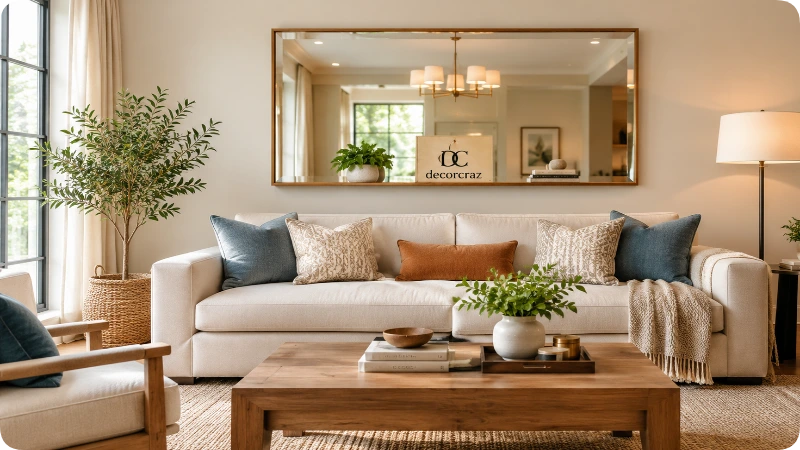
There is no single height that works for every living room because the correct position depends on whether the mirror is above a sofa, console, fireplace, or open wall.
For mirrors above furniture, many current design guides use roughly 6–12 inches between the furniture and the mirror as a starting point.
For an open wall, eye level placement can be a useful starting point, but the visual composition matters more than blindly following a number.
Above a Sofa
Keep the mirror visually connected to the sofa while leaving enough space to avoid making the wall feel cramped.
Above a Console
Center the mirror over the console and maintain a modest gap between the tabletop and mirror.
Above a Fireplace
Use the mantel and fireplace architecture as the primary reference points, while following any required safety clearances.
The best method is to create a temporary paper outline and inspect it from normal seating positions before installing the mirror.
How to Match Mirror Shapes to Living Room Styles
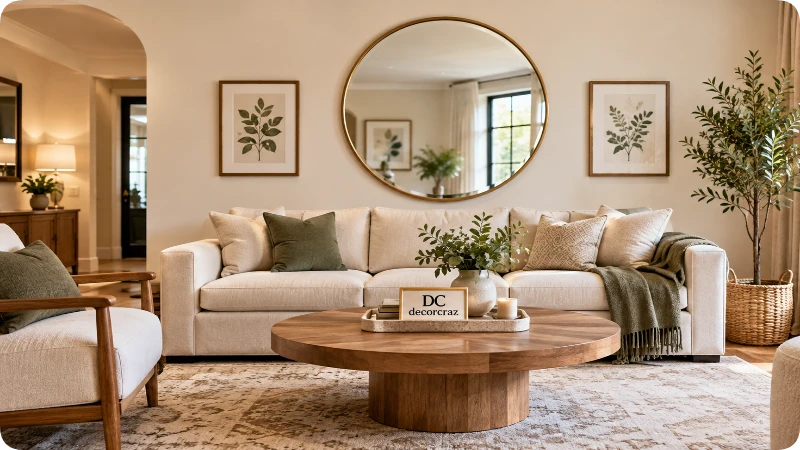
The mirror’s shape and frame can reinforce the decorating style of the room.
Modern
Use clean rectangular, round, arched, or geometric silhouettes with black, bronze, or minimal metallic frames.
Farmhouse
Wood frames, windowpane designs, distressed finishes, and warm neutral materials can complement farmhouse furniture and natural textures.
Boho
Try woven, rattan, irregular, or mixed frame mirrors. A small collection of varied mirrors can work especially well in a collected interior.
Traditional
Ornate gold, antique bronze, carved wood, and symmetrical arrangements can reinforce a classic living room.
Glam
Use sculptural frames, brass, gold, beveled details, or dramatic silhouettes, but keep the surrounding decor controlled.
Organic Modern
Choose arched, irregular, or rounded mirrors with natural wood or muted finishes. Pair them with linen, stone, plants, and warm wood.
The goal is not to make the mirror identical to every other object. It should share enough materials, shapes, or colors to feel intentional.
How to Style the Wall Around a Living Room Mirror
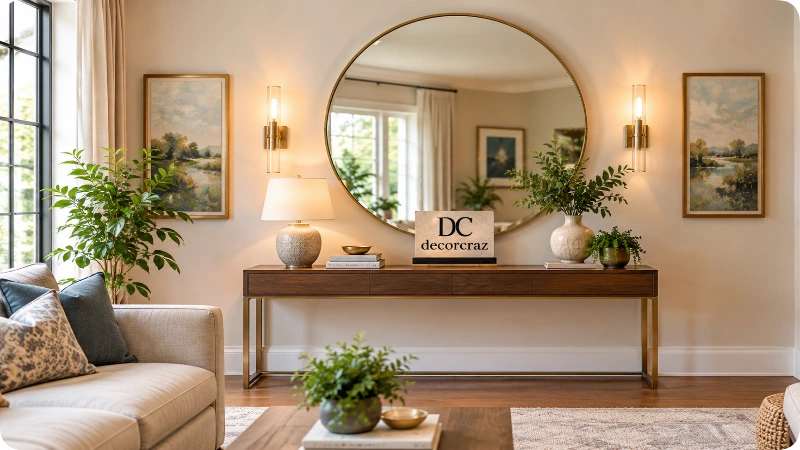
A mirror can be the starting point for the entire wall composition.
If the mirror is large and decorative, keep the surrounding wall relatively quiet. If the mirror is simple, you can introduce artwork, sconces, plants, or smaller decorative pieces around it.
Lighting can be particularly effective beside a mirror. Wall sconces or nearby lamps can add another layer of illumination, but check the reflection before finalizing the placement to avoid unwanted glare.
A console beneath the mirror can provide a visual base. Keep the surface edited: one lamp, a vase, a plant, books, or another small decorative object may be enough.
Remember that everything placed opposite the mirror becomes part of the visual composition through reflection.
Common Mirror Wall Decor Mistakes to Avoid
Choosing a Mirror That Is Too Small
A small mirror can look lost above a large sofa or on a wide blank wall. Test the dimensions with painter’s tape before purchasing.
Hanging the Mirror Too High
A mirror that sits far above the furniture can appear disconnected. Start with a modest gap and adjust based on the complete composition.
Ignoring What the Mirror Reflects
A mirror can double visual clutter just as easily as it can reflect attractive light and decor. Always inspect the reflection from the places where people actually sit.
Using Too Many Mirrors
Multiple mirrors can create excessive visual movement and repeated reflections. One strong mirror may be more effective than several unrelated pieces.
Matching Every Frame Exactly
A room can look overly coordinated when every frame has the same material. Repeating one or two details is usually enough to establish cohesion.
Forgetting Wall Construction
Large mirrors can be heavy. The appropriate mounting hardware depends on the mirror’s weight and the wall construction. Use hardware rated for the load and suitable for the wall material rather than relying on a generic hook.
For heavy or unusually large mirrors, professional installation can be appropriate, particularly where children, pets, or high traffic areas are involved.
Frequently Asked Questions About Mirror Wall Decor for Living Room
Where is the best place to put a mirror in a living room?
Good locations include above a sofa, above a console, above a fireplace, on a side wall near a window, or as part of a gallery arrangement. The best location is one where the mirror has a useful reflection and relates naturally to nearby furniture.
Should a living room mirror face a window?
A mirror can face or sit near a window when you want to reflect daylight or an attractive outdoor view. However, check for glare and make sure the resulting reflection is visually useful.
How big should a mirror be above a sofa?
A useful starting point is around two thirds to three quarters of the sofa’s width, but wall proportions and frame weight can change the ideal size.
How high should a mirror be above a sofa?
Begin with approximately 6–12 inches between the sofa back and the bottom of the mirror, then adjust based on the mirror’s size, sofa height, ceiling height, and overall composition.
Are round mirrors good for living rooms?
Yes. Round mirrors can soften rooms dominated by straight horizontal and vertical lines. They work particularly well above consoles, sofas, and in modern, transitional, farmhouse, and organic inspired interiors.
Can a mirror make a small living room look bigger?
A well positioned mirror can create a greater sense of visual depth and reflect light, which may make a room feel more open. The result depends heavily on what the mirror reflects and where it is positioned.
What should a living room mirror reflect?
Ideally, it should reflect something attractive such as daylight, greenery, artwork, an architectural feature, or open space. Avoid reflections of clutter, cables, harsh lighting, or visually distracting areas.
Conclusion
The best mirror wall decor for living room spaces starts with the room rather than the mirror itself. Consider the furniture beneath it, the wall dimensions, the amount of natural light, and most importantly, what the mirror will reflect.
An oversized mirror can anchor a sofa wall, a round design can soften a console, an arched mirror can add architectural character, and a carefully planned gallery can create a more collected look.Before installation, use painter’s tape or paper templates to test the size and position. Check the composition from normal seating areas, not just from directly in front of the wall.
Keep the surrounding decor edited and choose a frame that connects naturally with the room’s existing finishes. With the right proportion and placement, a mirror can function as both practical reflective decor and a strong visual feature.

I am Claudia Winkle, a passionate Name Researcher and Content Writer at decorcraz.com. I enjoy exploring the meanings, origins, history, and cultural significance behind names from around the world. Through carefully researched and engaging articles, I help readers discover unique names, understand their stories, and find meaningful naming inspiration for every occasion. My goal is to make name research simple, interesting, and useful for readers looking for the perfect name.