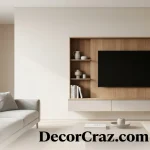
A TV can be useful without looking like the only thing happening on your living room wall. The trick is to design the whole wall, not just decorate the space around the screen.
The best living room TV wall decor ideas depend on what you need most. If the wall feels empty, texture or a gallery arrangement can give it structure. If the room lacks storage, a media console or built in cabinetry may solve two problems at once.
If you dislike seeing the TV when it is off, a framed screen, concealed cabinet, or carefully planned gallery can make it less dominant.
The right choice also depends on how permanent you want the change to be. A renter may prefer paint, removable panels, art, or a freestanding console, while a homeowner planning a renovation can consider millwork, recessed niches, or a full media wall.
The Best TV Wall Idea Depends on the Problem
Before choosing a style, decide what is wrong with your current TV wall.
| If Your TV Wall Feels… | Start With… | Why It Works |
|---|---|---|
| Blank | Wood paneling or large scale art | Adds structure without many small objects |
| Cluttered | Closed storage | Hides remotes, consoles, and cables |
| Too dark | Light wall color + controlled lighting | Keeps the wall visually lighter |
| Too plain | Texture or architectural paneling | Adds depth without filling the wall with decor |
| Too TV focused | Gallery wall or symmetrical shelving | Makes the screen part of a larger composition |
| Too small | Wide console or full width treatment | Gives the TV more visual context |
| Difficult to decorate | Built in framing | Creates a clear zone for the screen |
| Temporary/rental | Removable decor and freestanding furniture | Avoids permanent construction |
The most useful rule is simple: choose the treatment that fixes the wall’s biggest visual or functional problem.
Create a Warm Wood Panel TV Wall
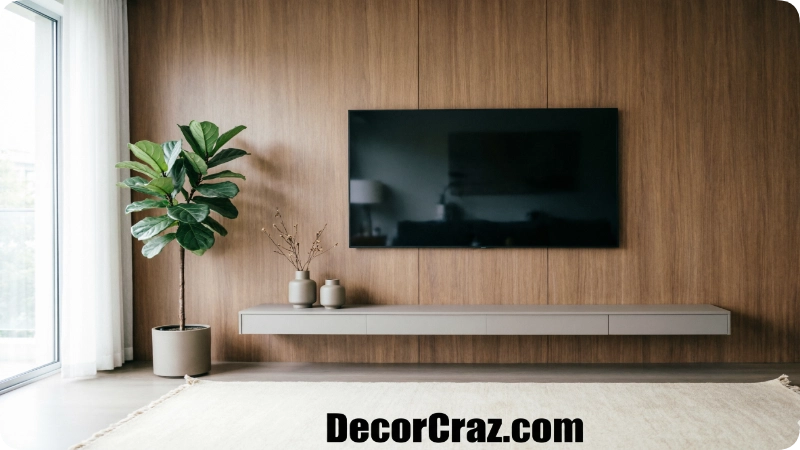
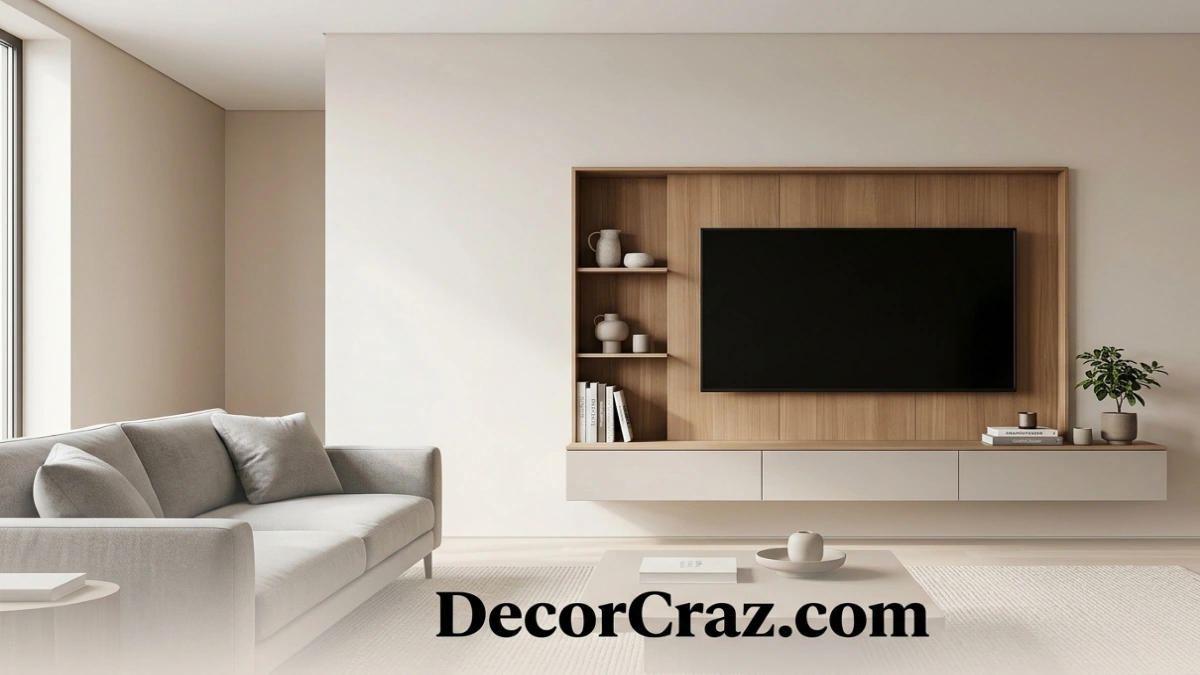
Wood paneling is one of the easiest ways to give a wall mounted TV a defined backdrop.
Vertical slats can make a wall appear taller, while wider wood panels create a calmer, more continuous surface. A wood look laminate or veneer can provide a similar visual effect without requiring solid timber.
The important part is scale. If the TV is large, a tiny panel behind it can look like a patch rather than a deliberate feature. Extend the treatment far enough to visually connect the television with the console or surrounding furniture.
Best for: modern, contemporary, Japandi, Scandinavian, and warm minimalist rooms.
Why it works: the repeated vertical or horizontal lines add texture while the relatively continuous surface prevents the wall from becoming cluttered.
Lower commitment option: use a removable or lightweight decorative panel system instead of permanent millwork.
Avoid: glossy wood finishes directly opposite strong windows. Reflections can compete with the screen.
Frame the TV With Built In Storage
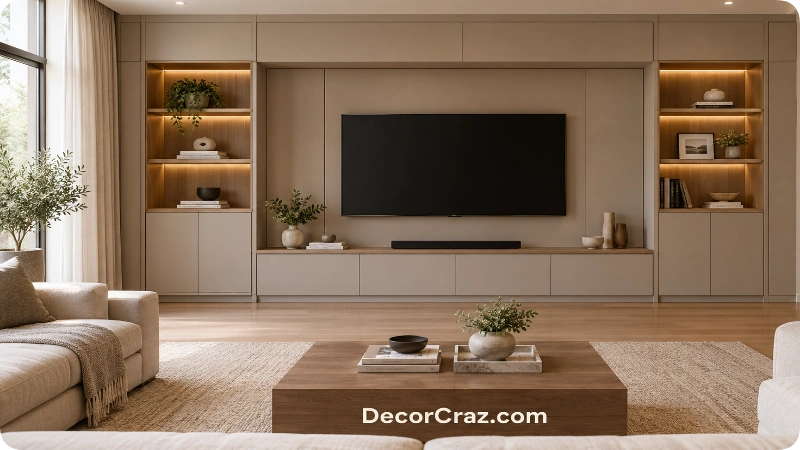
If your living room needs storage, make the TV wall work harder.
Built in cabinets can surround the television with closed cupboards, open shelves, or a combination of both. The TV then becomes one component of a larger architectural composition rather than a black rectangle sitting alone on the wall.
Closed storage is especially useful below or beside the TV because it can hide game consoles, routers, remotes, books, and other visual clutter.
A useful arrangement is to keep the area immediately surrounding the screen relatively quiet while placing decorative objects farther away from the center.
Best for: homeowners, family rooms, large walls, and rooms that need substantial storage.
Why it works: the cabinetry gives the TV a clear visual boundary while solving a practical storage problem.
Trade off: built ins require more money, planning, and commitment than paint or freestanding furniture.
If you are renovating, plan cable routes before the cabinetry is installed. Current TV design guidance also emphasizes concealing infrastructure early because retrofitting cables after construction can make a finished wall harder to keep clean.
Use a Long Floating Media Console
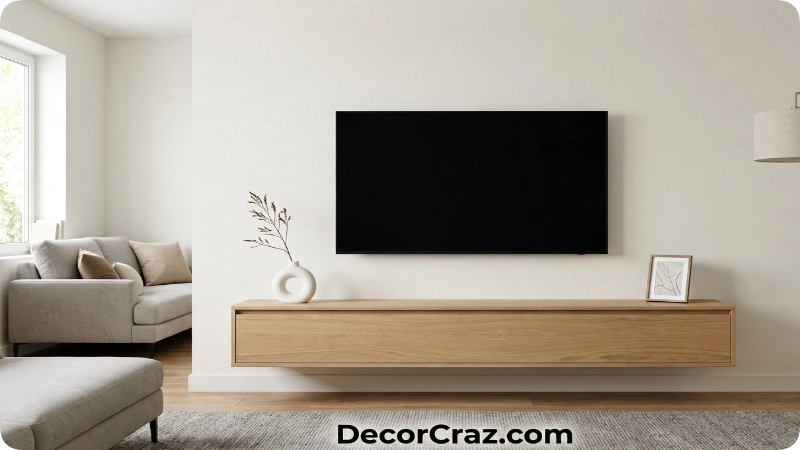
You do not need a full built in wall to make a TV area look intentional.
A long floating console can create a horizontal base beneath the television. This is particularly effective when the wall itself is simple.
Choose a console that visually relates to the width of the TV. A very narrow cabinet beneath a wide screen can make the television look oversized, while an appropriately wide console helps distribute the visual weight.
The floating design also leaves some floor visible, which can help a compact room feel less crowded.
Best for: small and medium living rooms, modern interiors, and people who want a clean appearance without major construction.
Why it works: the console connects the TV to the lower half of the room and provides storage without visually filling the floor.
Style it carefully: leave some empty space on the console instead of covering every inch with vases, books, candles, and accessories.
Turn the TV Into Part of a Gallery Wall
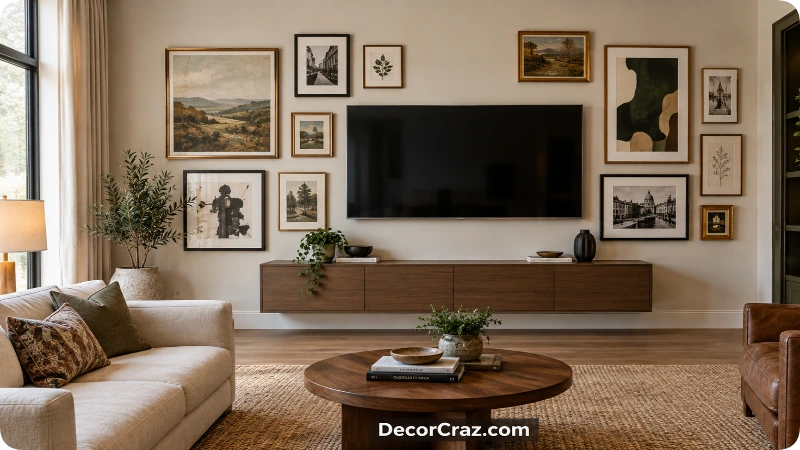
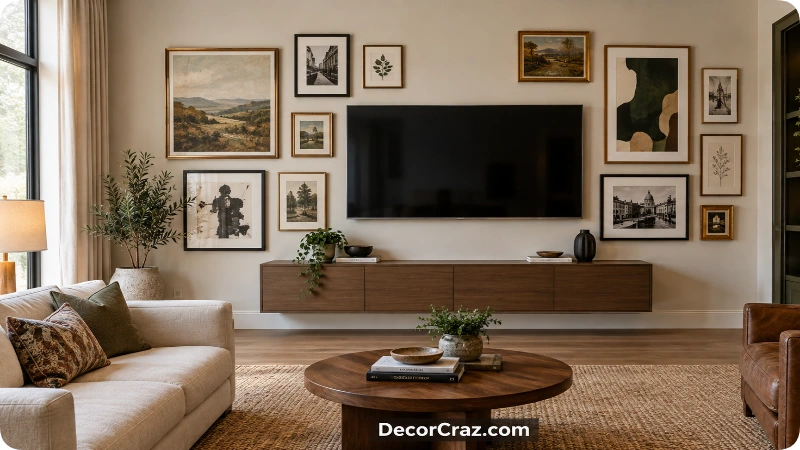
A gallery wall can be a good solution when you want the TV to feel less dominant.
Instead of treating the screen as something that must sit alone in the center, treat it as one large rectangular element within the overall composition.
Use artwork and frames that share a visual relationship through color, frame finish, subject, or spacing. The goal is not to crowd the TV. The goal is to create enough structure around it that the screen belongs to the composition.
A loose arrangement can work, but a deliberate grid is usually easier to control.
Best for: eclectic, traditional, transitional, collected, and personality driven interiors.
Why it works: the eye reads the entire arrangement rather than immediately isolating the television.
Watch out for: reflective glass. Bright reflections close to the TV can become distracting during viewing.
Current TV wall coverage also includes gallery compositions as a practical way to integrate a screen into surrounding decor.
Add Open Shelves for Controlled Decor
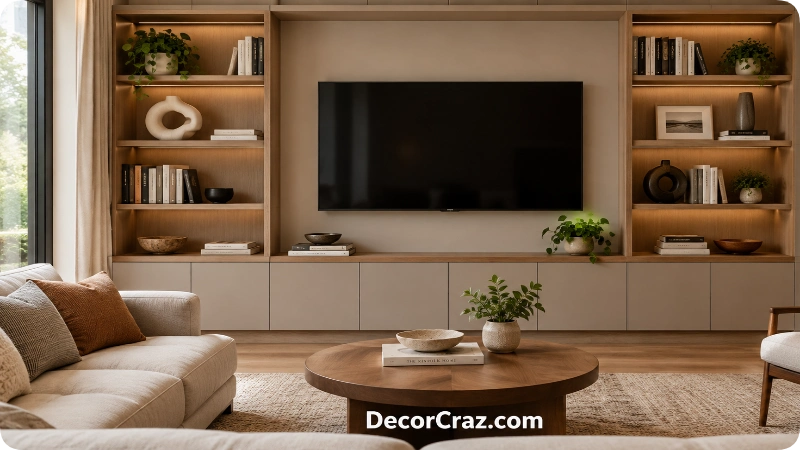
Open shelves can soften a TV wall, but only if they have a purpose.
Instead of filling shelves with many tiny objects, use a small number of larger pieces with different heights and textures. Books can provide visual weight, while a plant or sculptural object can break up the hard lines of electronics and shelving.
Asymmetrical shelving can make the wall feel more relaxed, while matching shelves on both sides of the TV create stronger symmetry.
Best for: people who want display space as well as media storage.
Why it works: shelves create vertical and horizontal lines that help connect the TV to the rest of the room.
Trade off: open shelves require maintenance. Dust, cables, remotes, and miscellaneous objects become visible quickly.
If your main problem is clutter rather than emptiness, closed cabinets are usually the better answer.
Use a Stone, Microcement, or Plaster Look Backdrop
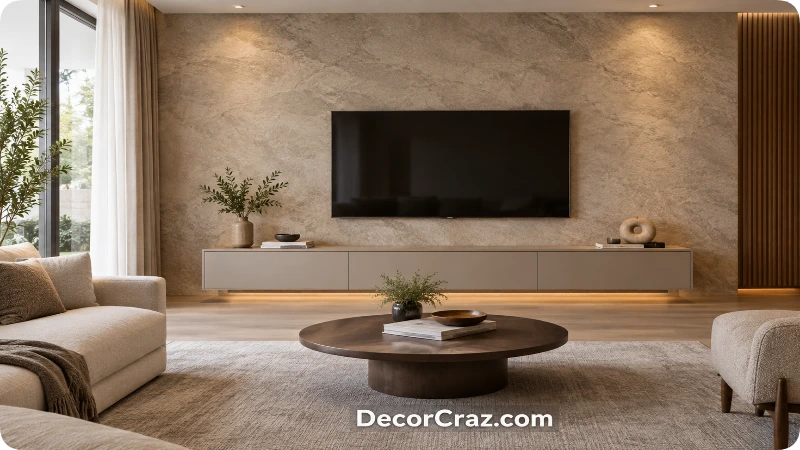
A textured mineral surface can give the TV wall architectural weight without adding shelves or lots of decoration.
Stone look porcelain, veneer, microcement, limewash style finishes, or plaster inspired surfaces can all create a stronger background for a television.
Keep the surrounding furniture relatively simple when the wall finish is visually strong.
This approach works particularly well when the rest of the room has restrained furniture and you want the wall itself to provide texture.
Best for: contemporary, modern, industrial, and luxury inspired interiors.
Why it works: the wall gains depth and material variation without needing multiple decorative objects.
Trade off: some materials are expensive, heavy, difficult to install, or difficult to reverse.
For a lower cost version, consider a textured paint treatment or a decorative panel that creates a similar visual rhythm.
Paint the TV Wall a Deeper or Coordinated Color
Sometimes the best TV wall decor is simply paint.
A darker or mid tone wall can visually reduce the contrast between a black TV and its background. A coordinated wall color can also make the television feel more integrated into the room instead of floating against a bright surface.
You do not have to choose black. Deep green, charcoal, muted blue, warm brown, taupe, or another color that already appears elsewhere in the room can work as a design direction.
The key is coordination rather than choosing a dramatic color simply because it is an accent wall.
Best for: renters with permission to paint, budget conscious updates, and rooms where construction is not practical.
Why it works: color changes the visual relationship between the screen, wall, furniture, and surrounding architecture.
Lower commitment option: use removable wallpaper or another reversible wall treatment where appropriate.
Build a Symmetrical TV Wall With Sconces
If you prefer order and balance, use matching elements on both sides of the TV.
Wall sconces are particularly useful because they introduce vertical forms and lighting without taking up floor space.
The sconces should relate to the TV’s size and the wall’s proportions. Very small fixtures beside a huge screen can disappear, while oversized fixtures can compete with it.
Keep the lighting controlled so it does not reflect directly across the screen.
Best for: traditional, transitional, contemporary, and symmetrical room layouts.
Why it works: matching elements visually distribute the weight of the TV.
Important: lighting placement should be planned with viewing in mind. Light sources and windows can create screen glare, so test the setup from the main seating position before permanently installing fixtures.
Hide the TV Behind Doors or a Decorative Panel
If you rarely want the television to be the focal point, hiding it may be a better solution than decorating around it.
A cabinet with doors, sliding panels, folding panels, or another concealed mechanism can allow the TV to disappear when it is not being used.
This approach makes particular sense in rooms that serve multiple purposes, such as formal living rooms, reading spaces, or entertaining areas.
Best for: homeowners who dislike the appearance of a large black screen when the TV is off.
Why it works: instead of making the television prettier, you remove it from the visual field when it is not needed.
Trade off: concealment systems add cost and require careful measurements around the TV, ventilation, connections, and opening mechanism.
Recent design coverage specifically highlights concealed TVs and integrated architectural solutions for multifunctional rooms.
Use a Frame Style TV as Art
A frame style television takes the opposite approach: rather than hiding the screen, make it look more like artwork when it is not being used.
This can work particularly well when the TV occupies a prominent wall in a living room where a conventional black screen would look visually heavy.
Choose artwork that relates to the room rather than selecting an image simply because the television can display it.
Best for: design focused living rooms where the TV remains visible most of the day.
Why it works: the screen becomes part of the decorative composition instead of looking purely technological.
Trade off: this solution depends on the specific television and its art display capabilities, so it can cost more than simply changing the wall.
Frame style TVs are also increasingly discussed as a way to integrate television technology into living room decor.
Create a Full Width Media Wall
A full width media wall treats the entire wall as one composition.
Instead of stopping the design directly around the TV, continue cabinetry, paneling, shelving, or another surface treatment across much of the wall.
This is especially useful when a television sits on a very wide or visually empty wall.
The design does not have to be symmetrical. You can combine a TV zone with storage, display shelving, a reading area, or decorative cabinetry.
Best for: large living rooms and wide feature walls.
Why it works: extending the treatment across the wall prevents the television from becoming an isolated rectangle.
Trade off: a full wall treatment can overwhelm a small room if too many materials, colors, and objects are combined.
Keep the palette controlled when the architecture is extensive.
Try a Minimalist Black on Black TV Wall
For a very clean look, make the television and its background visually similar.
A dark wall, dark panel, or dark built in can allow the TV to recede when the screen is off.
This works especially well when the surrounding furniture introduces lighter wood, fabric, stone, or other contrasting textures.
The wall does not need to be completely black. The important idea is to reduce the sharp contrast between the TV bezel and the surface behind it.
Best for: minimalist, contemporary, industrial, and modern rooms.
Why it works: the screen becomes less visually isolated.
Avoid: adding many unrelated black accessories simply to match the TV. The goal is visual integration, not a wall full of dark objects.
Make a Small TV Wall Feel Bigger
A small living room does not need a complicated TV feature wall.
Instead, use one strong horizontal or vertical element. A long floating console, slim shelves, a narrow panel, or a carefully placed piece of art may be enough.
Avoid filling every available inch because small rooms show clutter quickly.
If storage is necessary, prioritize closed storage and keep decorative items limited.
For compact spaces, proportion matters more than the number of decorations.
Best for: apartments, narrow living rooms, and rooms where floor space is limited.
Why it works: a controlled visual structure gives the wall definition without making the room feel crowded.
A small TV wall can also benefit from a lighter treatment if the room already has limited natural light.
Create a Rental Friendly TV Wall
Renting does not mean your TV wall has to remain completely bare.
Start with things that can move with you: a freestanding media console, framed artwork, removable wallpaper, lightweight decorative panels, floor lamps, and carefully positioned furniture.
A large piece of artwork beside or behind the TV can create more visual balance without permanent construction.
For cable management, use solutions appropriate to the wall and lease restrictions. Do not assume that every adhesive product is safe for every painted or textured surface.
Best for: renters and anyone who expects to move within a few years.
Why it works: the design creates a finished looking TV zone while keeping permanent alterations to a minimum.
Trade off: you will have fewer options for recessed wiring and custom built ins.
Combine Two Treatments Instead of Adding More Decor
Sometimes one treatment solves only half the problem.
For example, a wood panel can make the wall look better but provide no storage. A floating console can provide storage but leave a large blank area above the TV.
Combining two compatible treatments can solve both issues.
Try:
- Wood paneling + floating console
- Built in shelving + closed cabinets
- Painted wall + gallery arrangement
- Stone look backdrop + simple console
- Frame style TV + minimal wall treatment
- Open shelves + closed media storage
The important word is compatible.
If the wall already has strong texture, you may not need a gallery wall, bold wallpaper, several shelves, and decorative lighting on top of it.
Think in layers: one primary treatment, one supporting function, and enough empty space to let both read clearly.
How to Choose the Right TV Wall Idea
If you are stuck between several options, make the decision based on four questions.
Do you need storage?
Choose built ins, a media console, or a combination of open and closed cabinetry.
Do you mainly dislike the blank wall?
Choose paneling, paint, textured finishes, or a gallery composition.
Do you mainly dislike seeing the TV?
Consider a concealed TV, frame style television, or a wall treatment that reduces its contrast.
Do you rent or want a reversible update?
Choose paint where permitted, removable treatments, artwork, freestanding furniture, and other low commitment changes.
This approach is more useful than choosing a TV wall style by appearance alone because the same design can work beautifully in one room and poorly in another.
TV Wall Placement: Get This Right Before Decorating
Decor cannot compensate for a badly positioned television.
For comfortable viewing, manufacturer guidance generally recommends placing the center of the screen around seated eye level, with the exact position adjusted for the seating arrangement and TV model.
That means you should sit in the main viewing position before deciding where the TV goes.
Also consider:
- Window reflections
- Lamp placement
- Sofa height
- Viewing distance
- Soundbar position
- Power outlets
- Cable routes
- Wall construction
- Furniture beneath the screen
Samsung’s current guidance also recommends considering structural support, viewing distance, glare, and cable routing before mounting.
What about mounting the TV above a fireplace?
Treat this as a special case rather than a default TV wall solution.
A fireplace can push the screen higher than comfortable seated eye level, and heat can create a separate equipment concern. Samsung specifically warns about heat exposure and does not generally recommend mounting a TV over a fireplace without careful consideration.
If the fireplace is actively used, check the television manufacturer’s requirements and the actual temperature conditions before installation.
How to Keep a Decorated TV Wall From Looking Cluttered
The biggest mistake is trying to decorate every empty area.
Instead, give each object a job.
A shelf should provide display or storage.
A panel should provide texture or framing.
A console should provide storage and visual grounding.
A light should provide illumination and balance.
Artwork should provide visual interest or help integrate the TV into the composition.
If an item does none of those things, remove it.
Also watch scale. A tiny frame beside a large television can look accidental, while one large artwork piece may provide a stronger visual counterweight.
The goal is not to make the TV wall busy. It is to make the wall feel intentional.
Final Checklist Before You Finish the TV Wall
Before drilling, painting, or ordering custom furniture, check:
- Is the TV comfortable to watch from the main sofa?
- Does the screen face a window or strong light source?
- Is the wall strong enough for the chosen mount?
- Are cables and power connections planned?
- Does the console relate to the TV’s width?
- Is there enough storage for the equipment you actually use?
- Does the wall treatment match the rest of the room?
- Are decorative objects large enough to read from across the room?
- Is there enough empty space?
- Can the treatment be changed later if your needs change?
For wall mounting, follow the TV and mount manufacturer’s installation instructions. Samsung advises attaching mounts to appropriate structural support and checking the wall’s ability to carry the TV; its safety guidance also recommends having help when lifting larger televisions.
A beautiful TV wall is still a bad design if it creates a safety problem.
Frequently Asked Questions
What can I put on the wall around my TV?
You can use wood paneling, artwork, shelves, wall sconces, textured finishes, or built in cabinetry around your TV. Choose one main treatment based on whether you need decoration, storage, or a way to make the TV less noticeable.
How do I decorate a TV wall without making it look cluttered?
Start with one dominant feature, such as paneling, a gallery arrangement, or built in storage. Keep the area immediately around the screen relatively simple and avoid filling every shelf or empty space with small decorative objects.
Should a TV wall be lighter or darker?
Either can work. A darker wall can reduce the visual contrast of a black screen, while a lighter wall can make a small or poorly lit room feel more open. Choose the option that works with the room’s natural light and existing furniture.
How can I hide my TV when it is not in use?
You can conceal it with sliding panels, cabinet doors, a built in media unit, or use a frame style television that displays artwork when the screen is not being watched. The best choice depends on your budget and how permanent you want the installation to be.
What is the best TV wall idea for a small living room?
A floating media console, simple painted wall, slim paneling, or carefully planned storage usually works well in a small room. Avoid excessive shelving and small decorations because they can make limited wall space look busy.
How do I make a large TV look less dominant?
Give the TV a larger visual context. A wide console, full width paneling, built in cabinetry, or a balanced gallery arrangement can distribute the screen’s visual weight across the wall instead of leaving it isolated.
Is it a good idea to mount a TV above a fireplace?
It can be possible, but it should not be treated as the default location. The fireplace may place the TV too high for comfortable viewing, and heat can affect the equipment. Check the television manufacturer’s mounting and heat requirements before installing it above an active fireplace.
What should I consider before mounting a TV on a decorated wall?
Check the wall structure, mounting hardware, viewing height, viewing angle, glare from windows and lights, power access, and cable routing before installing the TV. Planning these details first prevents the finished wall from needing costly changes later.
Conclusion
The best living room TV wall decor ideas are not about adding as many decorations as possible they are about creating a balanced, functional, and intentional wall.
If you choose warm wood paneling, built in storage, a floating media console, open shelving, a gallery wall, textured finishes, or a concealed TV, the right option depends on your room size, style, storage needs, viewing habits, and budget. Before decorating, make sure the TV is positioned comfortably, glare is controlled, cables are planned, and the wall can safely support the installation. For smaller rooms, keep the design simple and prioritize proportion, while larger walls can handle full width treatments or layered features. Most importantly, start with one primary treatment and add only useful supporting elements.
A well planned TV wall should make the television feel naturally integrated into your living room without making the space look crowded.

I am Claudia Winkle, a passionate Name Researcher and Content Writer at decorcraz.com. I enjoy exploring the meanings, origins, history, and cultural significance behind names from around the world. Through carefully researched and engaging articles, I help readers discover unique names, understand their stories, and find meaningful naming inspiration for every occasion. My goal is to make name research simple, interesting, and useful for readers looking for the perfect name.