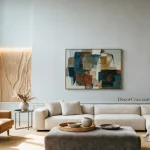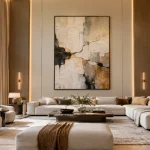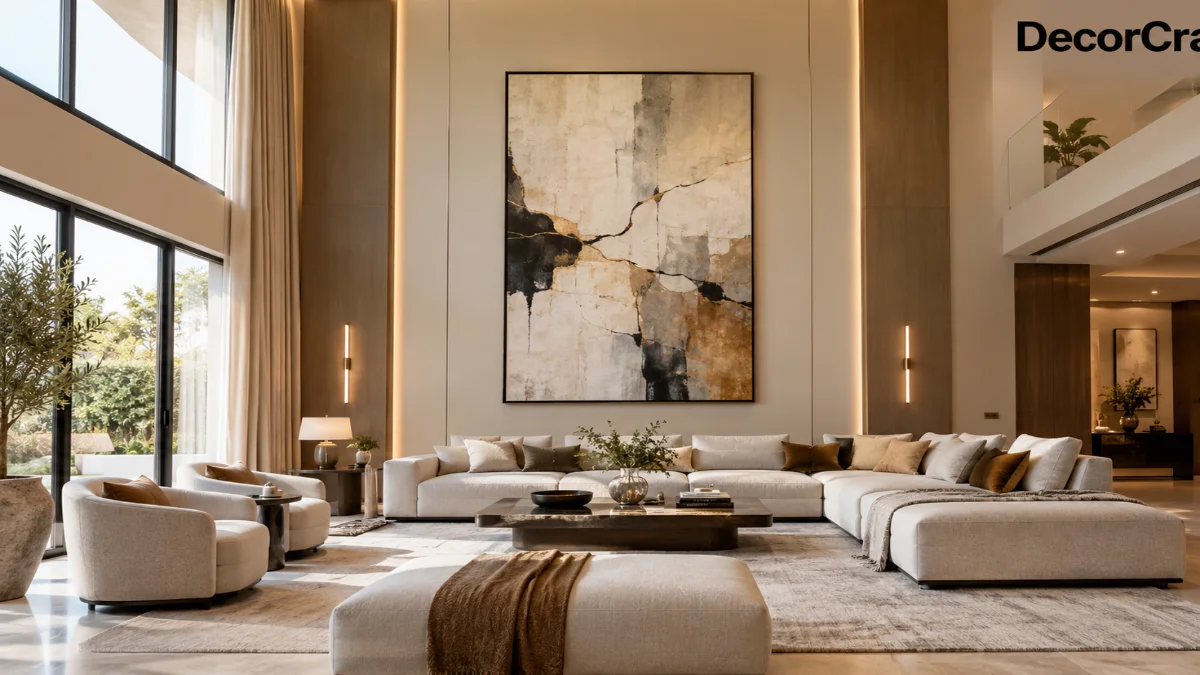
A large living room wall needs scale before decoration. The safest starting point is not to collect several small pieces and hope they fill the space. Instead, choose one clear anchor such as oversized artwork, a gallery composition, a large mirror, shelving, or an architectural treatment and size it around the furniture and wall.
The best choice depends mainly on four things:
- Wall width: A long wall benefits from horizontal compositions or repeated elements.
- Wall height: Taller walls can support vertical artwork, shelving, or full height treatments.
- Furniture below: A sofa, console, fireplace, or media unit gives the wall a visual anchor.
- Commitment level: Artwork is easy to change; paneling and built in are much harder to reverse.
Current large wall guides repeatedly favor oversized art, gallery arrangements, shelving, mirrors, textured treatments, murals, and built in because these solutions address the central problem: small decorations can look visually lost on an expansive surface.
Start With One Oversized Artwork
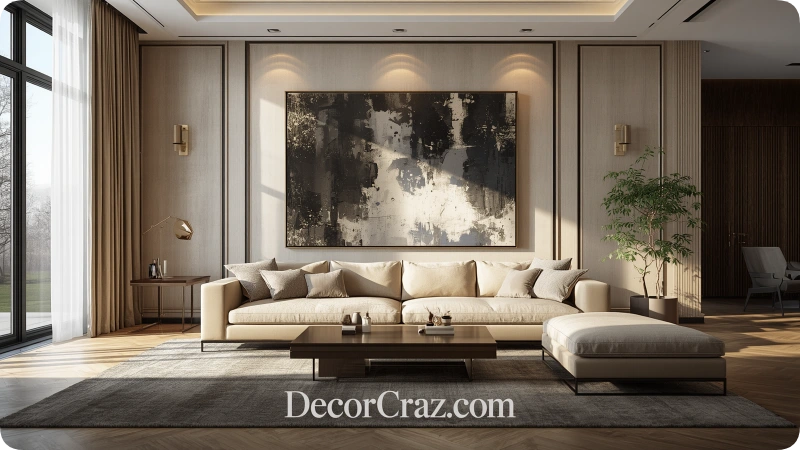
When a large wall feels empty but you do not want to redesign the entire room, one oversized artwork is usually the simplest solution.
Choose a canvas, framed painting, large photograph, or abstract piece that has enough visual weight to relate to the furniture underneath it. A small frame surrounded by acres of empty wall often makes the wall look even larger.
Why it works
One substantial piece creates a single focal point instead of scattering attention across the wall. It is especially useful when the sofa or console already provides a strong horizontal line.
Best for
- Modern living rooms
- Minimalist interiors
- Long sofas
- Walls where you want visual impact without many objects
How to make it fit
Center the artwork with the main furniture rather than automatically centering it on the entire architectural wall. Leave enough breathing room around the piece so it reads as intentional rather than squeezed into the available space.
For a quieter room, choose artwork that repeats one or two existing colors. For a neutral room, a stronger artwork can become the main source of contrast.
Avoid: Using a relatively small picture simply because it is the artwork you already own. If the piece is important to you, consider grouping it with additional pieces rather than leaving it isolated.
Build a Gallery Wall That Reads as One Composition
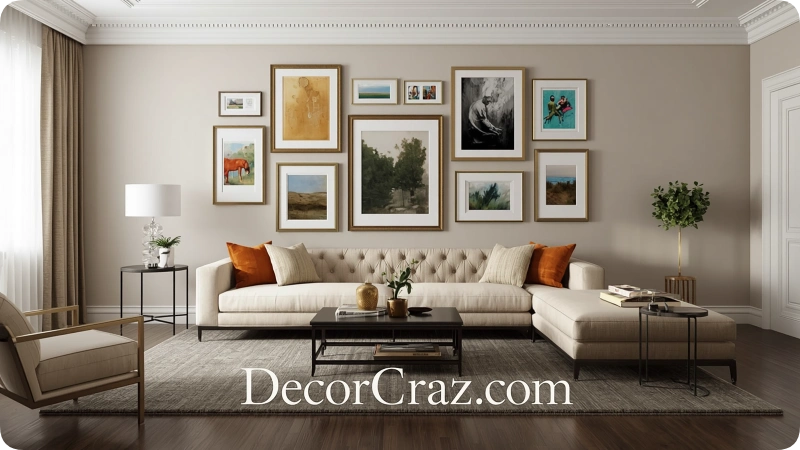
A gallery wall can fill a much larger area than a single picture, but the individual frames should still behave like one visual unit.
Instead of randomly filling every empty section, decide on the overall shape first. A wide rectangular arrangement works well above a long sofa, while a taller arrangement can suit a narrow or vertically oriented wall.
Choose a gallery style
Uniform grid: Best when you want a clean, structured appearance.
Mixed size gallery: Better for family photographs, collected artwork, or an eclectic interior.
Two or three column arrangement: Useful when the wall is tall and you want to emphasize height.
The key is consistency. You can mix photographs, illustrations, prints, and artwork, but repeat something frame material, mat color, artwork palette, or subject matter to keep the collection connected.
Before hanging
Lay the arrangement on the floor or create paper templates for the frames. This lets you adjust the composition before making holes in the wall. Both Home Depot and Lowe’s recommend planning the arrangement and using appropriate hanging hardware rather than improvising placement after installation.
Best choice when: You have several pieces you genuinely want to display.
Lower commitment alternative: Use a picture ledge so the artwork can be rearranged without repeatedly rehanging frames.
Use a Large Mirror When the Wall Needs Light as Well as Decoration
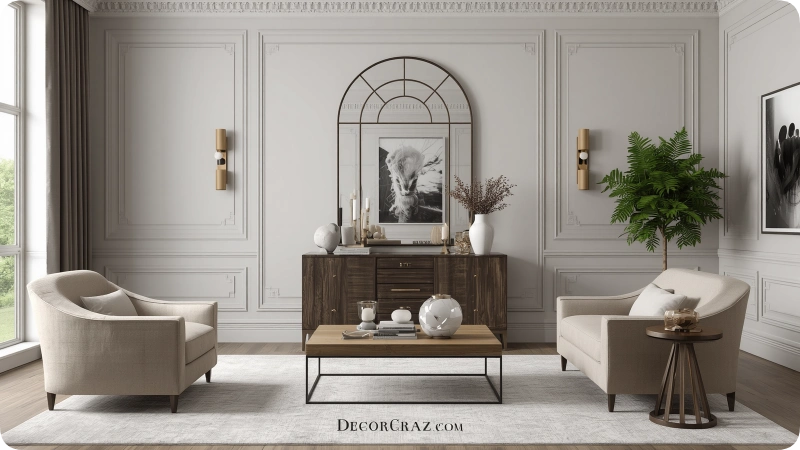
A large mirror can do more than occupy empty wall space. Its reflective surface can visually connect the wall with windows, lighting, or other parts of the room.
This makes a mirror particularly useful when the wall feels heavy or the room lacks visual brightness.
Where it works best
Place the mirror where it reflects something worth seeing such as a window, artwork, attractive lighting, or an open part of the room.
Avoid positioning a large mirror directly opposite an unattractive view simply because that section of wall is empty.
Choose the shape according to the room
- Round or arched: Softens rooms dominated by straight lines.
- Rectangular: Works naturally above long consoles and sofas.
- Multiple mirrors: Can create a decorative composition when one mirror does not provide enough scale.
A mirror can also be paired with wall lighting, but the lighting should support the mirror rather than compete with it.
Best choice when: You want the wall to feel substantial without adding visual heaviness.
Turn the Wall Into Storage With Open Shelving
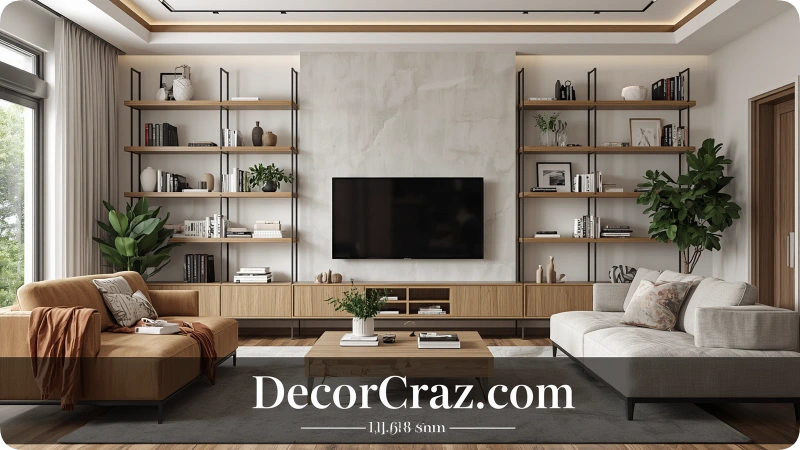
If your large wall needs to perform a practical function, shelving can be more useful than decorative art alone.
Long floating shelves, vertical shelving, or a combination of shelves can give the wall structure while providing space for books, ceramics, framed artwork, plants, or collected objects.
The important part is restraint. A large shelving system can quickly become a storage wall rather than a decorative feature.
Style shelves by visual weight
Place larger objects first, then smaller pieces around them. Leave some open areas so the shelves have visual breathing room.
You can also use artwork leaning against the back of shelves instead of hanging every piece directly on the wall.
Best for
- Readers who need additional display space
- Large blank walls without a strong architectural feature
- Rooms where storage and decoration need to coexist
Trade off: Open shelving requires ongoing editing and dusting. If you want storage that can conceal clutter, built in cabinetry is usually a better solution.
Create a Picture Ledge Wall for Flexible Decor
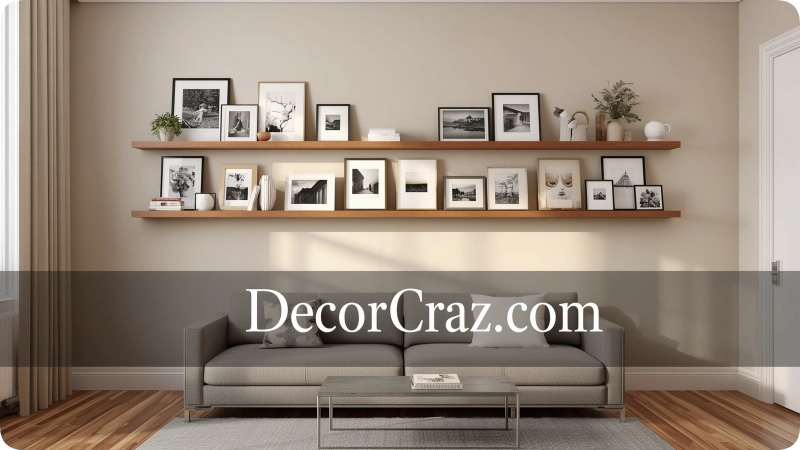
Picture ledges provide some of the flexibility of a gallery wall without requiring every frame to have a permanent position.
Install one or more ledges and layer framed artwork, photographs, small objects, and other lightweight decorative pieces.
This approach works especially well when you regularly change artwork or want to experiment with different arrangements.
Why it solves a large wall problem
A completely flat gallery can make a wide wall feel visually static. Layered ledges introduce depth while keeping the composition relatively easy to change.
Use fewer, larger pieces if the wall is very wide. Filling every ledge with small objects can create the same scale problem you were trying to solve.
Best for: Renters or anyone who likes to refresh their artwork.
Lower commitment option: A single narrow ledge can test the concept before installing a larger arrangement.
Add Wood Slats, Molding, or Decorative Wall Panels
When the wall itself needs to become the feature, architectural treatment can be more effective than adding objects.
Wood slats, decorative molding, fluted panels, geometric wall panels, or other textured surfaces create visual structure across the wall rather than placing separate decorations onto it.
Large wall design guides commonly identify paneling and textured treatments as solutions for expansive surfaces because they add scale and depth without depending on many individual objects.
Choose the treatment based on the problem
The wall feels flat: Add texture.
The wall feels too wide: Use vertical elements to interrupt the horizontal span.
The wall feels too tall: A strong horizontal division can visually reduce its height.
The room already has many decorative objects: A relatively simple wall treatment may work better than another collection of accessories.
Think about commitment
Paint and removable wallpaper are easier to change than installed paneling. Built in or permanently attached treatments require more planning because they influence future furniture and color decisions.
Use Wallpaper or a Mural When the Wall Needs a Complete Background
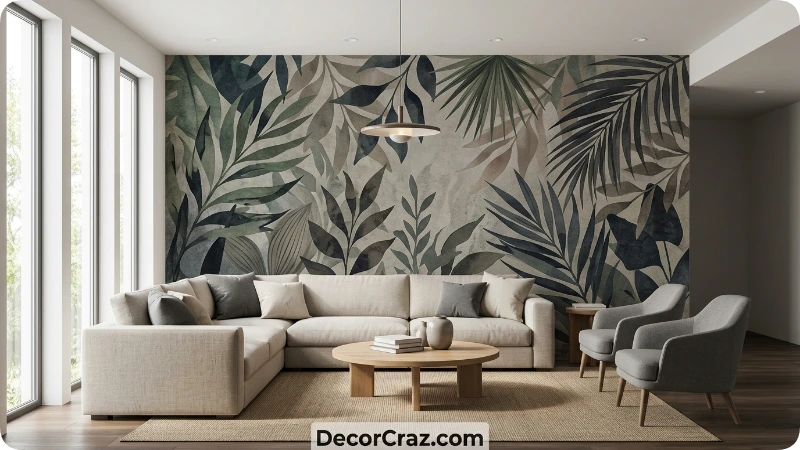
Sometimes the problem is not that the wall lacks decoration. It is that the wall lacks a visual background.
Wallpaper, a mural, or a painted feature wall can solve this by treating the entire surface as one composition.
This works particularly well when the furniture in front of the wall is relatively simple.
Keep the furniture quieter
A highly detailed mural behind a heavily patterned sofa, busy rug, and numerous accessories can create competing focal points.
If the wall covering is expressive, allow the furniture and accessories to support it rather than fight it.
Consider removable options
For renters or people who change styles frequently, removable wallpaper can provide a less permanent route than installed wall treatments.
Best choice when: You want the wall itself to make a statement rather than adding numerous objects.
Make a Media Wall or Built In the Main Feature
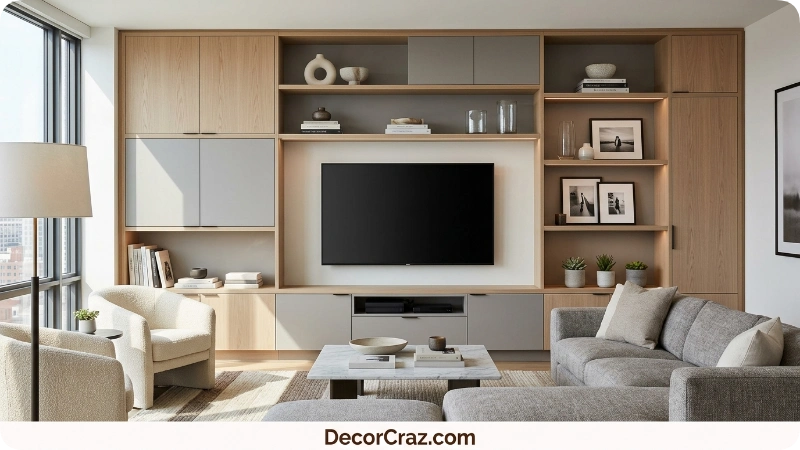
A large living room wall is sometimes better used for function than decoration.
A media wall, built in bookcase, cabinetry, or combination of closed and open storage can give a very large surface a clear architectural purpose.
This is particularly effective when the wall already needs to accommodate a television, fireplace, books, or storage.
Combine closed and open areas
Closed cabinets hide everyday clutter. Open shelves provide space for selected decorative objects.
This creates a useful balance: the wall looks intentional without requiring every item in the room to remain on display.
When to choose it
Choose a built in when you want the wall to solve a long term functional problem.
Do not choose it solely because the wall is empty. If you have no storage or media requirement, a built in may add unnecessary cost and permanence.
Lower commitment alternative: Freestanding shelving or a long console can provide some of the same function without permanently altering the wall.
Use Textiles or Sculptural Wall Art for Texture
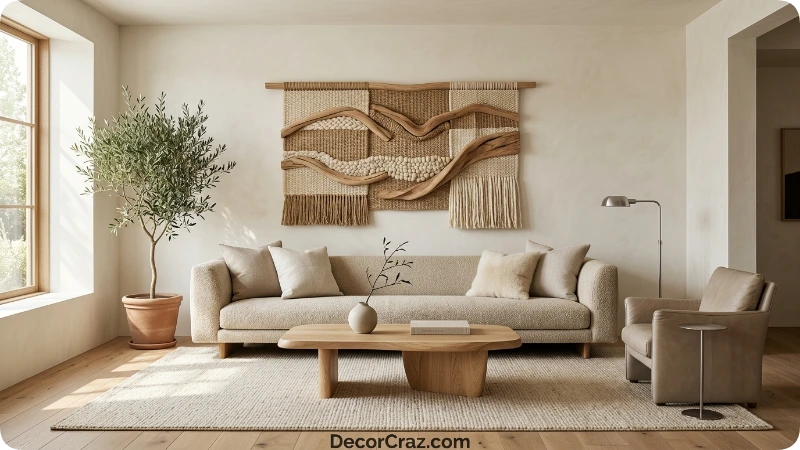
Large walls do not have to be filled exclusively with framed pictures.
A large textile, woven wall hanging, carved wood artwork, metal sculpture, or other dimensional piece can introduce texture without requiring a full architectural renovation.
This is particularly useful when the room contains many hard surfaces.
Why texture matters
A flat painted wall and a flat framed print can produce a visually similar surface. A textile or sculptural object introduces depth and changes how the wall interacts with light.
Keep the scale intentional
One substantial textile can work better than several tiny woven decorations scattered across the wall.
If the material already has a strong pattern or texture, keep the surrounding wall relatively simple.
Best for: Rooms where artwork feels too formal or where additional texture would balance hard furniture and surfaces.
Use Wall Lighting as Part of the Composition
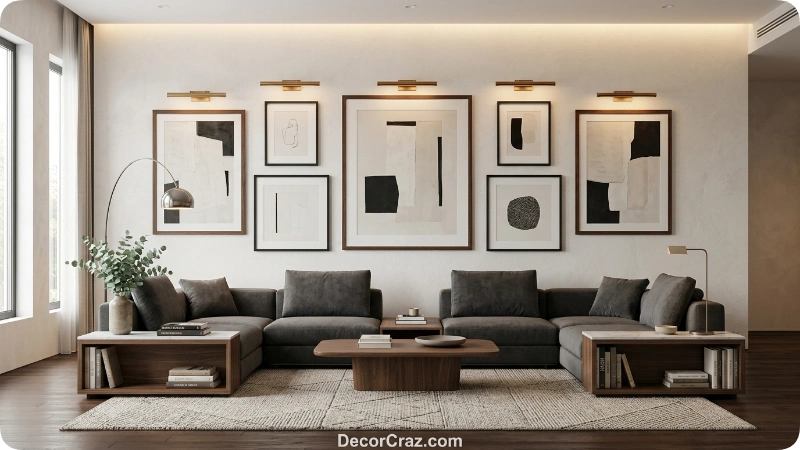
Lighting can become part of the wall design rather than merely illuminating it.
Picture lights, sconces, directional fixtures, or carefully positioned accent lighting can frame artwork and give an otherwise flat wall another layer of visual structure.
Large wall guides also identify sconces and picture lights as useful companions to artwork and mirrors.
Match the lighting to the wall feature
A picture light makes sense when artwork is the focal point.
Sconces can help structure a symmetrical arrangement around a mirror, fireplace, or central artwork.
Integrated lighting is especially useful with shelving or built ins because it combines function with display.
Important: Plan electrical locations before installing permanent wall treatments or built ins.
How to Choose the Right Large Wall Decor
If you are still unsure which solution fits, start with the wall’s actual problem.
| Your Wall Problem | Best Starting Point | Why |
|---|---|---|
| One huge blank surface | Oversized artwork | Adds scale without filling every inch |
| Several artworks already owned | Gallery wall | Turns separate pieces into one composition |
| Dark or visually heavy area | Large mirror | Adds reflection and visual openness |
| Need display space | Shelving | Combines decoration with function |
| Want flexibility | Picture ledges | Artwork can be rearranged easily |
| Flat or boring wall surface | Paneling or texture | Changes the wall itself |
| Want a dramatic backdrop | Wallpaper or mural | Treats the whole surface as one feature |
| Need storage/media function | Built-in | Gives the wall a practical purpose |
| Room lacks tactile texture | Textile or sculpture | Adds dimensional interest |
| Artwork needs emphasis | Wall lighting | Adds another layer to the composition |
How Large Should Wall Decor Be?
There is no single measurement that works for every living room because the furniture, wall proportions, ceiling height, and surrounding architecture all change the visual balance.
A better approach is to judge the decor as a composition, not as an isolated object.
For artwork above a sofa, the arrangement should feel clearly related to the sofa rather than floating independently on the wall. Common hanging guidance uses the furniture width and eye level placement as starting points, with the exact position adjusted for the room and composition.
Before purchasing anything, use painter’s tape to mark the approximate outer dimensions of the proposed artwork, gallery, mirror, or shelving.
Stand back from the normal viewing position.
If the taped shape already feels too small, buying a smaller piece will not solve the problem.
If it overwhelms the sofa, reduce the overall composition before committing.
Large Wall Decor Mistakes to Avoid
Using several tiny pieces without a larger structure
Small decorations can disappear on a large wall. Group them into a deliberate composition instead.
Decorating the wall without considering the furniture
The wall and furniture should read as one zone. Centering a piece on the architectural wall while ignoring the sofa or console can make the arrangement feel disconnected.
Filling every inch
A large wall does not need to be completely covered. Empty space can separate major elements and prevent visual clutter.
Mixing too many focal points
An oversized artwork, dramatic wallpaper, large mirror, television, and sculptural lighting may each compete for attention.
Choose the main focal point first.
Hanging heavy objects without checking the wall and hardware
Large mirrors, substantial artwork, shelving, and other heavy pieces need mounting hardware appropriate for both the item’s weight and the wall construction. Lowe’s and Home Depot both recommend securing heavy pieces to suitable framing or using appropriately rated anchors when framing is not available.
Ignoring the viewing height
A large piece can still look wrong if it is placed too high. Use the furniture, eye level, and overall composition to determine the final position rather than leaving a large gap simply because the wall is tall.
A Simple Way to Plan Your Wall Before Buying Anything
You do not need to start with a shopping list.
Start with the wall.
Step 1: Identify the anchor.
Is the wall centered around a sofa, fireplace, console, television, or open seating area?
Step 2: Measure the usable area.
Ignore sections blocked by doors, windows, vents, or architectural features.
Step 3: Pick one solution family.
Decide whether the wall needs art, reflection, storage, texture, architecture, or lighting.
Step 4: Mock up the scale.
Use painter’s tape or paper templates to mark the approximate size.
Step 5: Check it from the normal seating position.
A wall can look balanced when viewed close up but undersized from across the room.
Step 6: Add secondary elements only if necessary.
If the main solution already fills the visual role, stop there.
This last step matters. The goal is not to decorate every available section of wall. The goal is to make the wall and the room work together.
Frequently Asked Questions
What is the best decor for a large living room wall?
The best option depends on the wall and furniture. Oversized artwork is a strong choice for a simple decorative solution, while shelving or built in work better when you also need storage. A large mirror can help when reflection and light are priorities.
How do you decorate a very large blank wall?
Start by choosing one main focal solution rather than filling the wall with many small objects. Oversized artwork, a gallery arrangement, a large mirror, shelving, wall paneling, wallpaper, or a built in can give the wall enough visual weight. Mocking the size with painter’s tape before installation helps you judge the proportion from the seating area.
How do you make a large living room wall look less empty?
Use a decoration that relates to the width and height of the wall and the furniture beneath it. A larger artwork or gallery composition can fill visual space without covering every inch. If the wall still feels flat, adding texture through paneling, textiles, or shelving can create more depth.
Should wall art be centered with the wall or the sofa?
When the artwork is intended to decorate the seating area, it generally works better when its composition relates to the sofa or other furniture below it. A wall may be architecturally centered while the furniture is offset, so automatically centering artwork on the entire wall can sometimes make the arrangement feel disconnected.
How can I decorate a large wall without making the living room cluttered?
Choose one dominant wall treatment and keep supporting elements limited. For example, an oversized artwork can stand alone, while a gallery wall can provide the complete composition without requiring additional decorations around it. Leaving intentional empty space is often better than trying to fill every section.
What can I use instead of a gallery wall for a large living room wall?
Good alternatives include one oversized artwork, a large mirror, floating shelves, picture ledges, decorative wall paneling, wallpaper, a large textile, sculptural artwork, or a built in media and storage wall. The right choice depends on whether your priority is decoration, flexibility, texture, reflection, or storage.
Conclusion
Decorating a large living room wall is mainly about finding the right balance between scale, function, and visual simplicity. Instead of filling an expansive wall with many small decorations, start with one strong anchor that relates to the sofa, console, fireplace, or media area.
Oversized artwork, gallery walls, large mirrors, shelving, picture ledges, paneling, wallpaper, textiles, sculptural art, and built ins can all work well when chosen according to the wall’s size and the room’s needs. Before installing anything, measure the usable wall area and use painter’s tape or paper templates to test the composition from the normal seating position.
Most importantly, avoid trying to fill every inch. A thoughtfully scaled focal point with intentional empty space can make a large living room feel polished, balanced, and inviting without creating unnecessary visual clutter.

I am Claudia Winkle, a passionate Name Researcher and Content Writer at decorcraz.com. I enjoy exploring the meanings, origins, history, and cultural significance behind names from around the world. Through carefully researched and engaging articles, I help readers discover unique names, understand their stories, and find meaningful naming inspiration for every occasion. My goal is to make name research simple, interesting, and useful for readers looking for the perfect name.