Artificial plants can solve a very specific decorating problem: you want greenery in a room, but a real plant does not fit the light, maintenance, or placement needs of that space.
The best artificial plants for home decor are not simply the biggest or most realistic looking options. They need to fit the room’s scale, work with the furniture around them, and have a shape and container that make sense in the space.
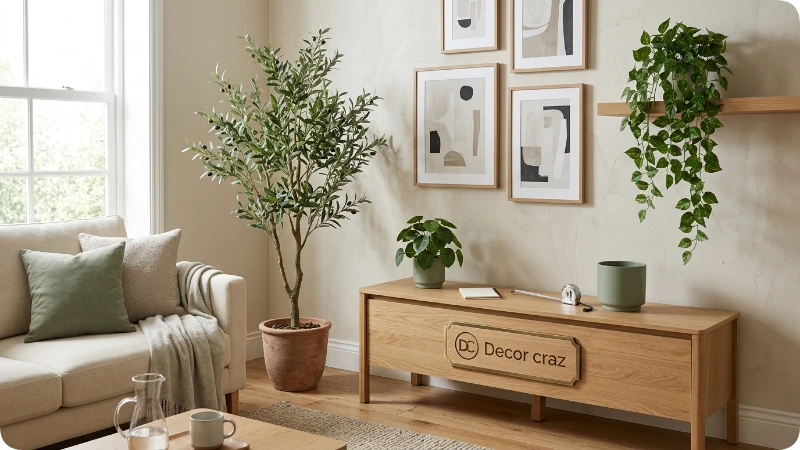
A small trailing plant can soften an open shelf, while a tall, narrow tree can fill an empty corner without adding another piece of furniture.
The key is to treat faux greenery as part of the room’s composition rather than as something added just to fill an empty spot.
Start With the Right Artificial Plant for Your Space
Before choosing a plant, look at the space you want to change.
Ask three practical questions:
- How much room is available?
- Is the plant viewed close up or from across the room?
- Do you need height, softness, color, or a small decorative accent?
These questions usually narrow the choice faster than shopping by plant name.
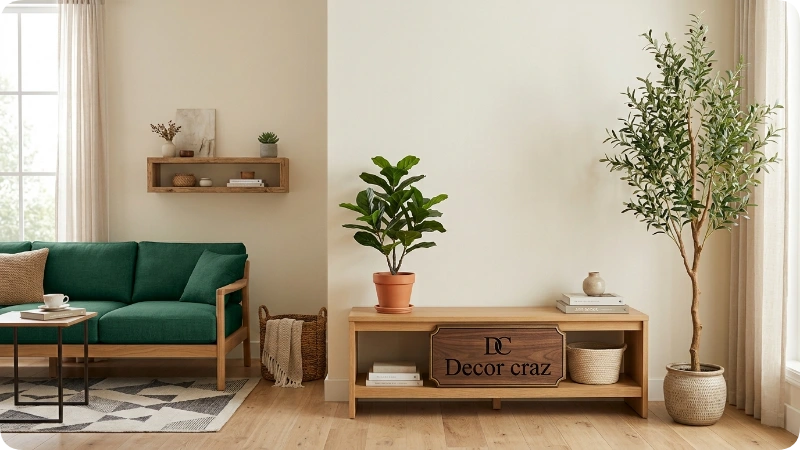
For a large empty corner, a tall artificial tree can provide vertical structure. On a console, a composed arrangement or a few stems may work better. For a shelf or desk, a compact plant keeps the greenery within the scale of the furniture.
The plant should support the room rather than compete with its main furniture and architectural features.
Choose Plants by Their Job, Not Just Their Appearance

Different artificial plants solve different decorating problems.
Use a tall plant to fill vertical space
A tall olive tree, fiddle leaf fig, palm, or similar upright form works well when a room has an empty corner that feels visually unfinished.
Choose a relatively narrow silhouette when the room is compact. A wide, dense tree can make a small seating area feel crowded.
Use a trailing plant to soften hard lines
Trailing vines and hanging greenery work particularly well on open shelves, cabinets, bookcases, and high ledges.
Their value comes from the downward movement. Instead of adding another upright object, they break up straight horizontal and vertical lines.
Use a tabletop plant for small scale decoration
Small artificial succulents, ferns, orchids, or leafy plants can work on desks, bedside tables, consoles, and bathroom counters.
The important part is keeping the plant small enough that it does not block useful space or important sightlines.
Use a floral arrangement when you need a focal point
Artificial flowers can work better than green foliage when a dining table, entry console, or coffee table needs color rather than height.
A simple arrangement is often easier to integrate than several unrelated decorative plants.
Make Scale Work With Your Furniture
Scale is one of the biggest factors in whether artificial greenery looks intentional.
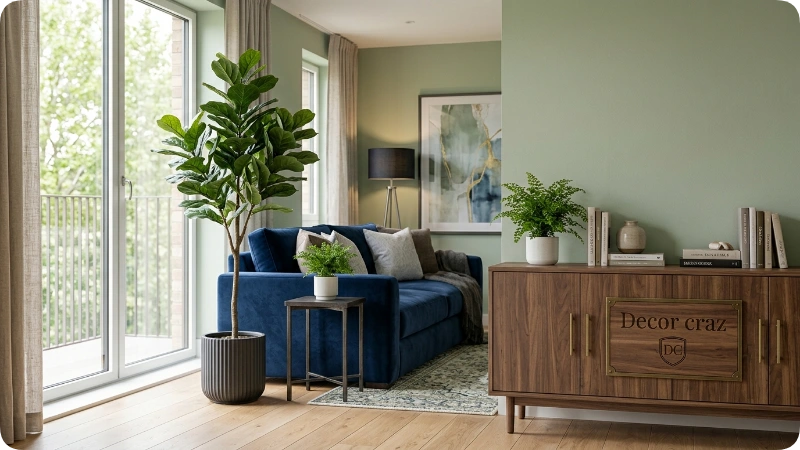
A tiny plant can disappear beside a large sofa. A very tall, wide plant can overwhelm a narrow walkway. The answer is not always to buy a medium sized plant; sometimes the space needs a distinctly tall or distinctly small silhouette.
Think about the furniture beside the plant.
A floor plant should have enough visual presence to hold its position beside a sofa, cabinet, or substantial chair. A tabletop plant should relate to the surface it sits on rather than becoming the main object on the surface.
For shelves, avoid a plant that is awkwardly tall for the shelf but too small to function as a floor accent. A compact upright or a trailing form usually makes more sense.
The exact dimensions depend on your room, furniture, and viewing distance, so measure the available area before buying.
Pick a Realistic Plant Before You Worry About the Pot

A decorative planter can improve an artificial plant, but it cannot completely disguise a poor quality plant.
Look closely at the foliage before buying. Useful realism cues include:
- Slight variation in leaf color
- Different leaf angles and sizes
- Visible leaf texture or veining
- Flexible stems that can be shaped
- A finish that does not look excessively glossy
- A natural looking overall silhouette
Real plants rarely grow in perfect symmetry. A faux plant with identical leaves arranged at identical angles can therefore look artificial even when its basic shape is attractive.
Current styling guides consistently emphasize irregular shaping, realistic foliage, suitable containers, and keeping faux plants clean as important parts of making them look convincing.
Upgrade the Container
The container is part of the design, not an afterthought.
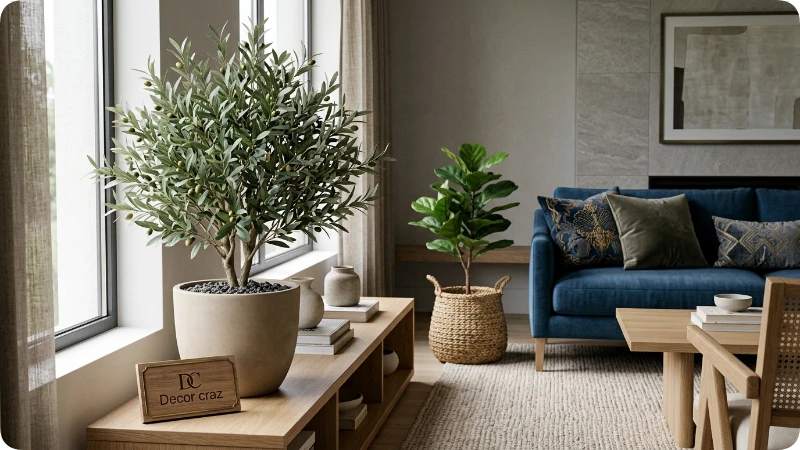
Many artificial plants come with a small functional pot designed primarily to hold the plant upright. That pot may not suit the room.
Instead, consider:
- Matte ceramic for a clean interior
- Terracotta for warmer, earthy rooms
- Woven baskets for relaxed spaces
- Stone or concrete finishes for contemporary rooms
- Glass or decorative vessels for artificial stems
Choose a container that repeats a material, color, or texture already present in the room.
For example, a woven basket can connect with a natural fiber rug, while a ceramic planter can repeat the finish of nearby pottery.
A larger outer pot can also give a tall artificial plant a stronger visual base. If the original container remains inside it, make sure the plant is stable and cannot easily tip.
How to Make Artificial Plants Look More Natural

Even a good faux plant can look stiff when it first comes out of its packaging.
Shape the stems
Gently separate compressed branches and vary their angles.
Avoid making every branch perfectly even. A slightly irregular shape gives the plant a more natural silhouette.
Separate the leaves
Spread crowded leaves so they do not form a flat, artificial looking mass.
Step back occasionally and look at the plant from the distance at which you normally see it.
Hide the artificial base
If the base is visible, cover it with an appropriate decorative material such as moss, bark, or stones, provided the material is secure and suitable for the container.
This makes the plant look more deliberately planted rather than simply placed inside a pot.
Keep it clean
Dust is particularly noticeable on artificial foliage because the plant does not receive natural washing from rain or regular watering.
Use the cleaning method recommended for the material and manufacturer. HGTV specifically recommends regular cleaning as part of keeping faux plants convincing.
Style Artificial Plants Room by Room
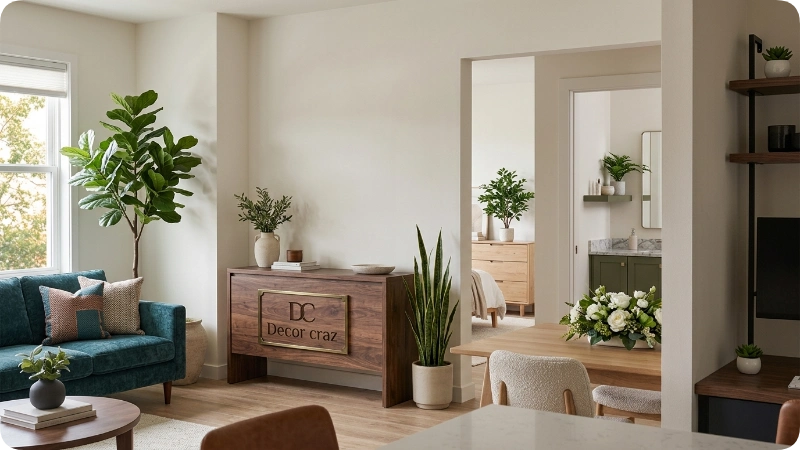
Living Room
The living room usually benefits from one strong plant rather than many unrelated pieces.
Place a tall artificial tree in an unused corner beside seating or near a cabinet where it can fill vertical space without blocking movement.
For a smaller living room, choose a narrower tree or a medium plant on a side table.
The goal is to balance the furniture, not create a miniature indoor jungle.
Bedroom
Bedrooms generally suit quieter, smaller arrangements.
Try a compact artificial plant on a dresser, bedside table, or shelf. A trailing plant can also soften a tall bookcase or storage unit.
Keep the placement practical. Do not position a large floor plant where it interferes with drawers, doors, walking space, or cleaning.
Entryway
An entryway benefits from plants that establish height without narrowing the passage.
A slim upright plant can work beside a console or in a corner. If floor space is limited, use a small arrangement on the console instead.
Keep walkways clear and avoid placing a fragile container where bags, shoes, or doors can knock into it.
Dining Room
A dining table needs a centerpiece that does not interfere with conversation or visibility.
Low artificial arrangements are usually easier to live with than very tall plants in the middle of the table.
For a sideboard or console, a taller arrangement can work because it does not sit directly between diners.
Bathroom
Artificial greenery can be useful where natural light is limited or where maintaining a live plant would be inconvenient.
Choose a compact plant for a vanity or shelf and keep it away from locations where water regularly splashes onto materials that are not designed for moisture.
A trailing shape can work especially well from a high shelf because it uses vertical space without taking up the counter.
Home Office
A small artificial plant can add visual variation without taking over the desk.
Keep it away from the keyboard, monitor, documents, and other frequently used areas. A compact pot in a corner of the desk or a small shelf plant can provide the effect without reducing usable workspace.
Use Artificial Plants in Small Homes
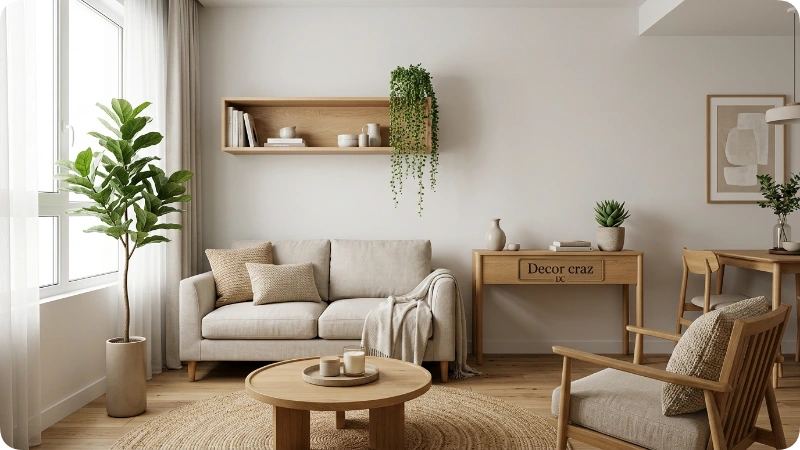
Small spaces do not necessarily need tiny plants everywhere.
Instead, choose plants according to the amount of floor and surface space available.
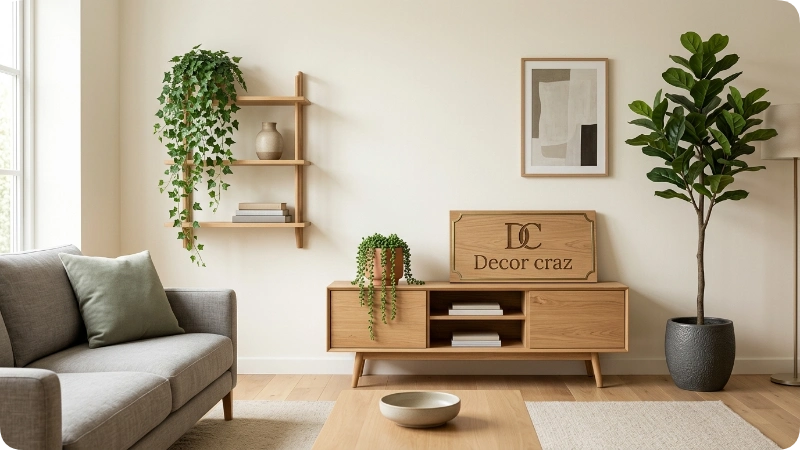
A narrow floor plant can add height without taking much width. A hanging or trailing plant can use vertical space. A small arrangement can occupy an otherwise unused shelf.
Avoid filling every empty corner. One well scaled plant can have more impact than several small plants competing for attention.
For renters, removable and movable options are particularly practical because they do not require permanent installation.
Combine Different Heights Without Making the Room Busy

If you use more than one artificial plant in a room, vary their roles.
For example, one tall floor plant can establish height while a smaller tabletop plant adds a lower point of greenery.
The difference should be visible rather than extremely subtle.
Also vary silhouettes. A tall upright plant beside another nearly identical upright plant can look repetitive. Combining an upright form with a trailing or compact form creates more visual contrast.
The goal is not to collect every type of faux plant. It is to create a clear relationship between the pieces you actually need.
When Artificial Plants Are a Better Fit Than Real Plants
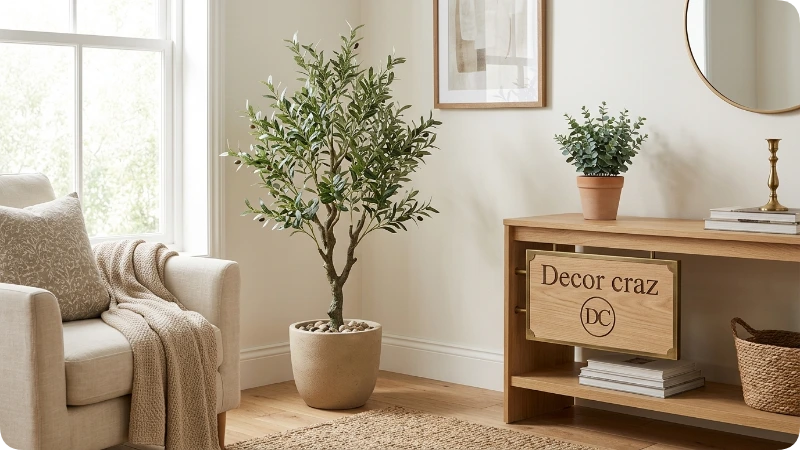
Artificial plants make practical sense when the main goal is visual greenery rather than living plant care.
They can be useful in spaces where watering is difficult, where consistent plant care does not fit the household routine, or where a decorative plant needs to maintain a particular shape.
They do not provide the biological characteristics of living plants, however. If you want a living plant and have the appropriate light and time for care, a real plant remains a different choice rather than something an artificial plant can completely replace.
A useful approach is to mix the two when appropriate: use real plants where their living qualities matter and artificial greenery where consistency and low maintenance matter more.
When Artificial Plants Can Look Wrong
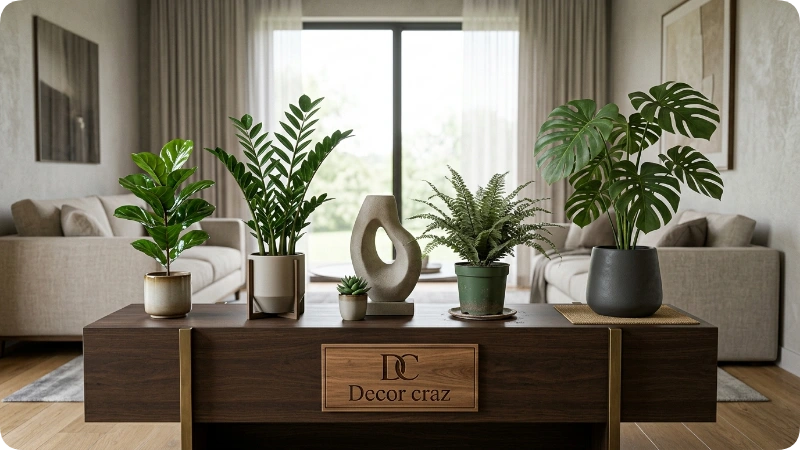
Artificial plants are not automatically stylish simply because they are convenient.
They tend to look less convincing when:
- The leaves are highly glossy or obviously plastic
- The plant is perfectly symmetrical
- The pot looks like a temporary nursery container
- The plant is badly undersized or oversized
- Several identical plants are repeated without purpose
- Dust has accumulated on the leaves
- The plant is placed somewhere that makes little visual sense
Recent design coverage also highlights unrealistic, shiny, dusty faux foliage as a common reason artificial plants can look cheap or distracting.
If a plant does not look right, changing its position or container may help. But if the foliage itself looks obviously artificial, better styling has limits.
Protect Artificial Plants From Avoidable Wear

Artificial does not mean indestructible.
For longevity, follow the manufacturer’s care instructions, especially for materials exposed to strong sunlight or outdoor conditions. Home Depot’s artificial plant guidance recommends checking quality and keeping faux plants away from direct sunlight for the longest life, while other guides note that UV resistant materials are more appropriate where sunlight exposure cannot be avoided.
Also consider stability.
A tall plant in a lightweight container can be easy to knock over. In busy areas, use a stable planter and make sure the plant’s base is secure.
If children or pets can reach the plant, inspect it for exposed wire, loose decorative pieces, or small detachable components and follow the manufacturer’s safety information.
A Simple Buying Checklist
Before purchasing an artificial plant, check:
1. Size: Will it fit the available floor or surface area?
2. Shape: Does the silhouette solve the decorating problem?
3. Realism: Do the leaves have believable color, texture, and variation?
4. Container: Will the included pot work, or will you need an outer planter?
5. Placement: Does the plant make sense where you plan to put it?
6. Maintenance: Can you easily reach it for dusting and cleaning?
7. Durability: Will the material work for the amount of light and use the location receives?
8. Stability: Is the base heavy and secure enough for the space?
This checklist helps prevent a common decorating mistake: choosing the plant first and discovering afterward that it is the wrong size, shape, or container for the room.
Artificial Plant Ideas by Decorating Problem
| Your decorating problem | Plant type to consider | Why it works |
| Empty living room corner | Tall tree | Adds vertical structure |
| Narrow entryway | Slim upright plant | Uses height without taking much width |
| Bare bookshelf | Trailing plant | Softens hard horizontal lines |
| Empty desk corner | Small potted plant | Adds greenery without using much workspace |
| Dining table centerpiece | Low floral arrangement | Adds color without blocking conversation |
| Bathroom shelf | Compact tropical or leafy plant | Fits small surfaces |
| Large open room | Tall statement plant | Helps balance large furniture and empty vertical space |
| Small apartment | Narrow floor plant or hanging greenery | Uses vertical space efficiently |
The Easiest Way to Choose
Start with the space, then choose the plant shape, then the container.
If the room needs height, look for an upright floor plant. If it needs softness along a shelf, choose something trailing. If a surface feels empty, use a compact arrangement. If a corner feels unfinished, choose a plant with enough scale to hold that position.
Then check realism and finish the look with a container that belongs to the room.
Artificial plants work best when they solve a specific decorating problem. You do not need many of them. You need the right shape, in the right place, at the right scale.
FAQs
How do I make an artificial plant look real?
Start with realistic foliage, then reshape the stems and leaves so they are not perfectly symmetrical. Put the plant in a suitable decorative container, hide an artificial looking base when appropriate, and keep the foliage clean.
What size artificial plant should I choose?
Choose according to the furniture, available floor or surface space, and viewing distance. A large room can support a stronger vertical statement, while a small shelf or desk usually needs a compact plant. Measure the space before purchasing rather than relying only on the product photo.
Are artificial plants tacky in a house?
Not necessarily. The result depends heavily on realism, scale, placement, container choice, and maintenance. Shiny foliage, poor proportions, dusty leaves, and an unsuitable pot can make artificial plants look distracting, while a well scaled and carefully styled piece can integrate with the room.
Can I mix artificial and real plants?
Yes, if both fit the room and your decorating goals. Real and artificial plants provide different qualities, so place each where its particular advantages make sense rather than trying to make them identical.
Conclusion
Artificial plants for home decor can be a practical way to add greenery without the regular watering and care that real plants require. The key is choosing pieces that suit your space, furniture, and decorating style.
Consider the plant’s size, shape, realism, and placement before buying, and choose a planter that complements the room. Tall plants can fill empty corners, trailing plants can soften shelves, and smaller options can add greenery to desks, consoles, and bedrooms.
To keep artificial plants looking natural, shape the stems, separate the leaves, hide visible bases, and clean the foliage regularly. You do not need many plants to make an impact.

I am Claudia Winkle, a passionate Name Researcher and Content Writer at decorcraz.com. I enjoy exploring the meanings, origins, history, and cultural significance behind names from around the world. Through carefully researched and engaging articles, I help readers discover unique names, understand their stories, and find meaningful naming inspiration for every occasion. My goal is to make name research simple, interesting, and useful for readers looking for the perfect name.