Blank walls can make a living room feel unfinished, but filling every open area with decoration can create a different problem: visual clutter. The most effective approach is to decide what the wall needs to do first.
It may need a focal point above the sofa, more light in a dark corner, storage around the TV, texture on a plain surface, or a low commitment solution for a rental. For most living rooms, start with one dominant wall treatment or arrangement, then add only what supports it.
A large artwork, gallery wall, mirror, shelf display, textile, or architectural treatment can each work well when its scale relates to the furniture and wall around it.
The right choice depends more on the wall’s proportions, what sits beneath it, available light, and how permanent you want the change to be than on simply following a decorating trend.
Looking for decoration ideas for living room walls? From oversized artwork and gallery walls to decorative mirrors, floating shelves, and textured wall treatments, there are plenty of ways to make your walls more attractive and functional.
Choose decorating ideas for living room walls that complement your furniture, available space, lighting, and personal style.
Start With the Wall’s Job Before Choosing Decor
The fastest way to choose living room wall decor is to identify the problem you are trying to solve.
If the wall is above a sofa, the decor should visually connect with the seating. If it is a large uninterrupted wall, you need enough visual weight to prevent small pieces from looking lost. A dark wall may benefit from reflective or lighter elements, while a TV wall usually needs a composition that makes the screen feel integrated rather than competing with it.
Use this simple decision guide:
| Your Wall Situation | Strong Starting Option | Why It Works |
|---|---|---|
| Above a sofa | Oversized art or gallery arrangement | Creates a clear focal point |
| Large blank wall | Large art, gallery, shelving, or architectural treatment | Provides enough visual scale |
| Small living room | One large piece or mirror | Avoids scattered visual clutter |
| Dark room | Mirror or light toned artwork | Adds reflection or visual brightness |
| TV wall | Shelving, art integration, or restrained backdrop | Helps the TV feel intentional |
| Rental | Leaning art, lightweight frames, or removable solutions | Limits permanent changes |
| Empty corner | Vertical art, mirror, or narrow display | Uses height without crowding the floor |
Before buying anything, look at the furniture below the wall. Art or a decorative arrangement generally feels more connected when its overall width relates to the furniture beneath it. A commonly used starting point is around two thirds of the furniture width, although the exact proportion should change with the wall, furniture shape, and composition.
Make Oversized Artwork the Main Focal Point

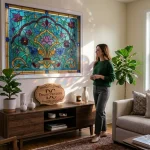
A single large artwork is one of the simplest solutions when a living room wall needs a strong visual anchor.
Choose a horizontal piece above a sofa or console when the furniture is wide. A vertical artwork can work better beside a window, fireplace, doorway, or other narrow section where horizontal art would feel cramped.
The important part is scale, not simply choosing the largest artwork available. A tiny print can disappear above a large sectional, while an enormous piece can overwhelm a compact sofa.
For artwork above furniture, a useful starting point is to make the complete artwork or grouping roughly two thirds the width of the furniture below it.
How to make one artwork feel connected
- Repeat one color from the artwork somewhere else in the room.
- Use the sofa, console, or fireplace as the visual anchor.
- Choose a horizontal composition for wide furniture.
- Leave enough surrounding wall visible so the piece can breathe.
- If the room already has strong patterns, let the artwork provide quieter contrast.
For an open wall without furniture, centering the artwork around average standing eye level is a useful starting point. Several current hanging guides place the center around 57–60 inches from the floor, but furniture, ceiling height, and viewer height can justify adjustments.
Build a Gallery Wall for Personality and Variety
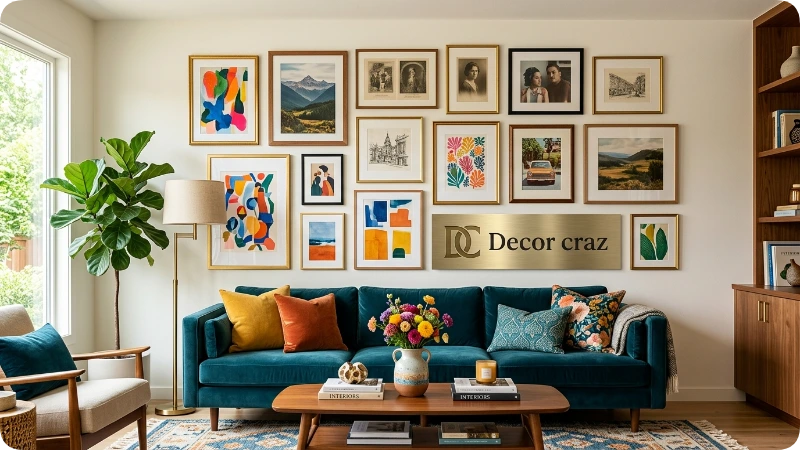
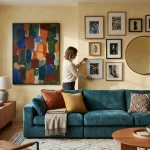
A gallery wall is useful when one artwork cannot provide enough interest or when you have several pieces you genuinely want to display.
The key is to treat the entire gallery as one composition rather than hanging individual frames independently. The outer boundaries should relate to the sofa, console, fireplace, or architectural feature beneath them.
You can use:
- Family photographs
- Abstract prints
- Landscapes
- Vintage artwork
- Illustrations
- Personal travel pieces
- Small sculptural objects
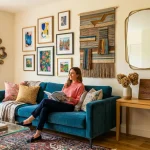
Matching frames create a more controlled appearance, while different frames can produce a collected look. Both approaches can work if another element such as color, subject, spacing, or scale creates a visual connection. Gallery walls are also useful for visually defining areas in an open plan living space.
Plan the arrangement before making holes
Place the frames on the floor first, then adjust the arrangement until the overall shape feels balanced. You can also use paper templates or painter’s tape on the wall to test the footprint before installing anything.
Keep spacing deliberate. Current wall art guidance commonly uses approximately 2–3 inches between nearby frames as a starting point, but larger compositions may need more breathing room.
Use a Mirror When Light and Depth Matter
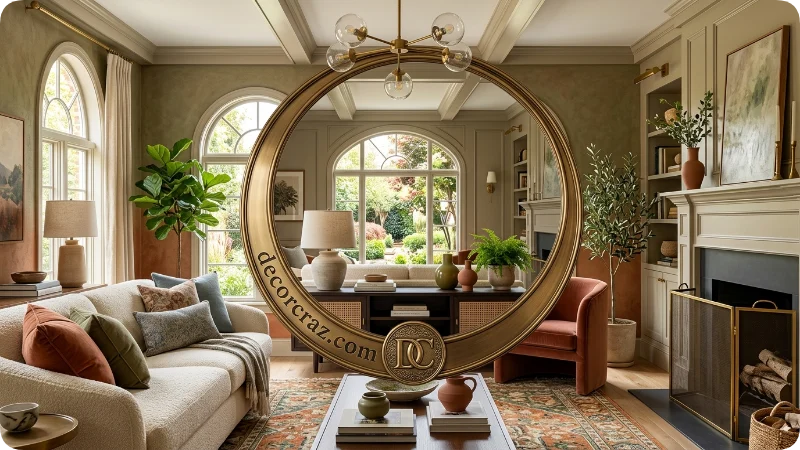
A mirror can solve more than an empty wall problem. It introduces reflection, which can make a room feel more open while visually extending light or views.
This makes a mirror particularly useful in:
- Smaller living rooms
- Darker rooms
- Narrow spaces
- Walls opposite windows
- Areas where artwork would add too much visual detail
The most important decision is what the mirror reflects. A mirror facing an attractive window, plant, artwork, or architectural feature can reinforce that element. A mirror reflecting a cluttered shelf or unattractive utility area can have the opposite effect. HGTV similarly recommends considering the view captured by a mirror rather than treating reflection as an afterthought.
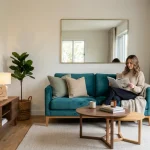
A round mirror can soften a room dominated by rectangular furniture. A tall mirror can emphasize ceiling height, while a wide mirror can better relate to a long sofa or console.
For heavy mirrors, use mounting hardware appropriate to the mirror’s weight and wall construction rather than treating it like lightweight artwork.
Add Picture Ledges or Shelves for Flexible Display

Shelves are useful when your wall needs both decoration and function.
A picture ledge can hold artwork, photographs, books, and small objects while allowing you to change the arrangement without reinstalling every piece. IKEA specifically recommends shelves and picture ledges as flexible ways to display art and personal objects while reducing the need for numerous wall holes.
Keep a shelf arrangement visually controlled
Start with one larger piece toward the back. Add smaller objects in front or beside it, then leave some empty space.
This works better than filling every inch with accessories.
For a long wall, a continuous ledge can create a horizontal line that connects separate seating areas. For a narrow wall, a shorter ledge with vertically arranged artwork can draw attention upward.
If the shelf will carry books, ceramics, or other heavy objects, select anchors and mounting methods suitable for the wall material and expected load.
Bring Texture to the Wall With Textiles and Sculptural Decor
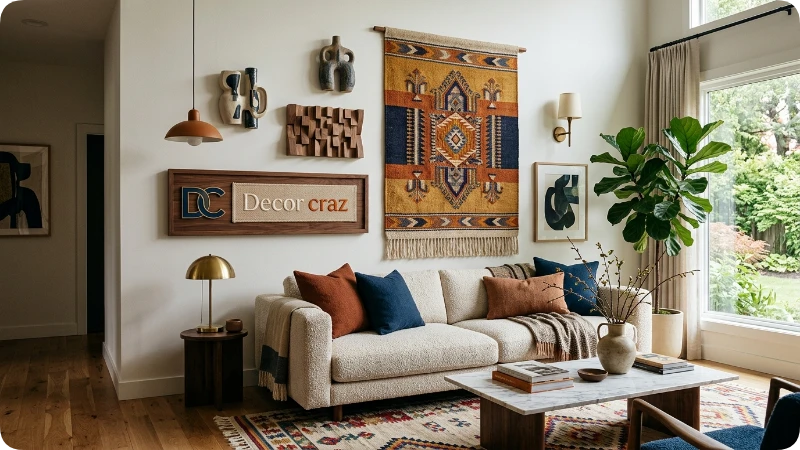
Not every living room wall needs framed artwork.
Textiles, woven pieces, ceramic objects, metal sculpture, wood elements, and other dimensional decor can give a flat wall more physical variation. Architectural Digest’s current living room guidance also identifies wall sculpture, textiles, woven pieces, and other three dimensional alternatives to conventional framed art.
This approach works particularly well when the room already contains substantial artwork and you want something visually different.
Choose texture according to the room
A woven textile can soften a room with hard furniture and surfaces. Metal sculpture can introduce sharper contrast into a soft neutral room. Wood can repeat existing flooring, furniture, or trim.
Avoid adding texture simply because the wall is empty. The material should have a reason to be there softening contrast, repeating an existing material, creating a focal point, or adding dimensional interest.
Treat the TV Wall as Part of the Room

The TV does not have to become the only visual element on a media wall.
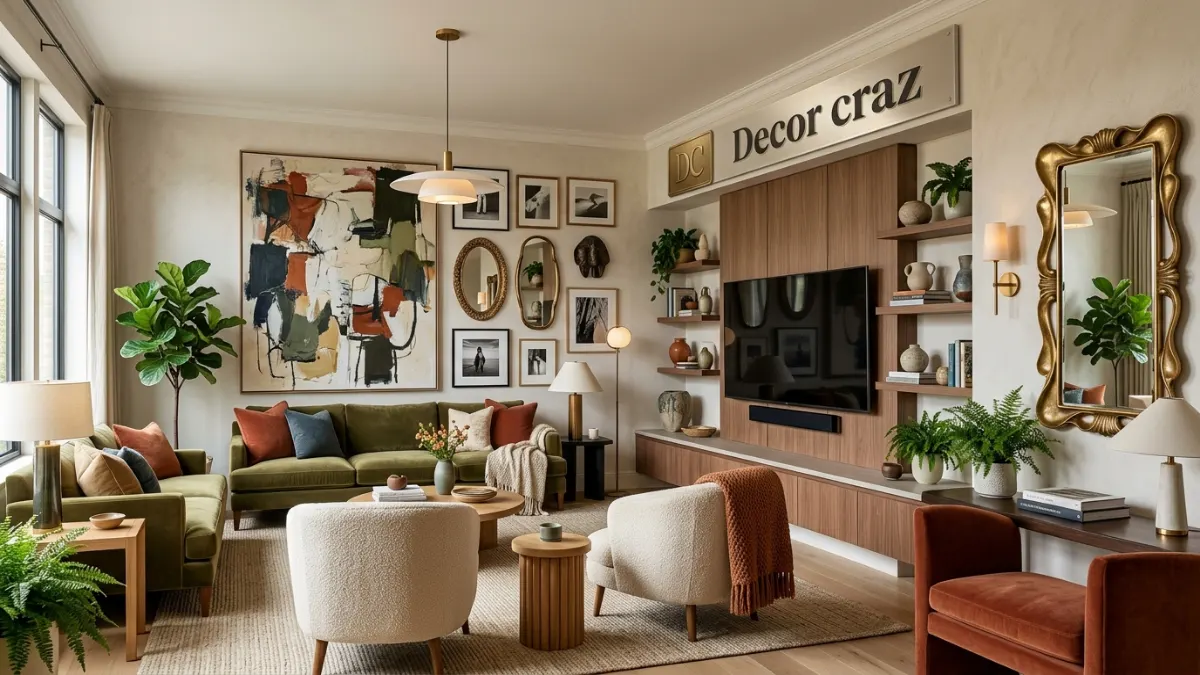
Instead of placing random decorations around the screen, build a composition around the television. Shelving, cabinetry, artwork, lighting, or a restrained textured backdrop can help the screen sit within the overall design.
One practical approach is to use vertical or horizontal storage around the TV. This gives the wall a purpose while providing space for books, media equipment, photographs, or decorative objects.
Another option is a simple backdrop such as wood paneling or a painted wall treatment. The goal is not to disguise the television at all costs; it is to make the entire wall read as one intentional zone.
IKEA shows both storage led and collage style approaches to decorating TV walls, while HGTV examples include built ins that combine display and functional storage.
Keep access to cables, ventilation, controls, and equipment in mind before building around the screen.
Use Wall Paneling, Paint, Wallpaper, or Trim for a Built In Look
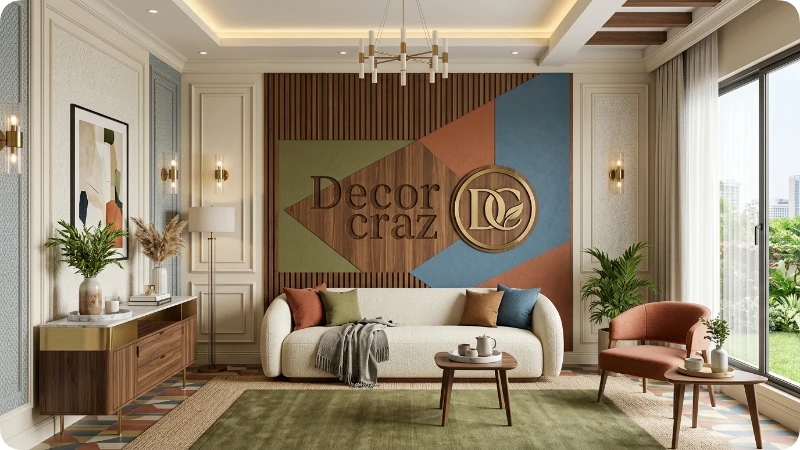
If you want the wall itself to become the decoration, change its surface rather than adding more objects.
Possible treatments include:
- Vertical wood slats
- Decorative wall molding
- Wainscoting
- Wallpaper
- Limewash style finishes
- Painted geometric areas
- Textured panels
- Tile or stone accents
Architectural Digest’s recent coverage highlights textured wallpaper, sculptural plaster, tile, and wood paneling among current approaches to three dimensional living room walls.
This option makes sense when the wall is large enough to support a continuous treatment or when the architecture already gives you a natural boundary.
When to choose a surface treatment
Choose it when you want a stronger backdrop and don’t want to constantly rearrange objects. Avoid it when you are likely to change your decorating style frequently or when the wall’s architecture already feels busy.
For renters, removable wallpaper may provide a lower commitment alternative, but always check the product’s instructions and test compatibility with the existing wall surface before covering a large area.
Solve Large or Awkward Walls With a Wider Visual Footprint

A large blank wall does not automatically need one enormous object.
The better question is: how much visual territory needs to be occupied?
For a long wall behind a sofa, you could use:
- One oversized horizontal artwork
- A wide gallery composition
- A long picture ledge
- Several coordinated artworks
- A combination of shelving and art
- A wall to wall architectural treatment
For a tall, narrow wall, change direction. Use vertically oriented artwork, a tall mirror, a stacked arrangement, or narrow shelving.
Large walls can also support built ins, bookshelves, or a combination of storage and display. The Spruce’s large wall guidance identifies oversized artwork, mirrors, built ins, wallpaper, shelving, textiles, and architectural finishes as distinct ways to handle expansive surfaces.
The main mistake is using several undersized pieces simply because they are available. If the composition occupies too little of the wall, it can look accidental rather than intentional.
Choose Low Commitment Wall Decor for Rentals and Frequent Changes

Renters do not need to leave their living room walls empty.
The lowest commitment options include leaning artwork, freestanding screens, lightweight frames, removable decor, and displays that use existing furniture as support. A leaning artwork arrangement on a sturdy console can create substantial visual impact without attaching the artwork directly to the wall.
For adhesive hanging systems, do not assume that “removable” means suitable for every wall or every object. Manufacturer instructions vary by product. For example, 3M’s Command instructions specify surface conditions, weight limits, application procedures, and restrictions for particular products.
Before using adhesive hardware
Check:
- The exact weight of the complete object.
- The product’s stated weight and surface limits.
- If your wall finish is compatible.
- If the paint is sufficiently cured.
- If the item is valuable, fragile, or potentially hazardous if it falls.
For heavy mirrors, large framed glass, or substantial shelving, use a properly rated mechanical mounting solution appropriate to the wall instead of relying on a generic adhesive strip.
How to Choose the Right Size and Placement
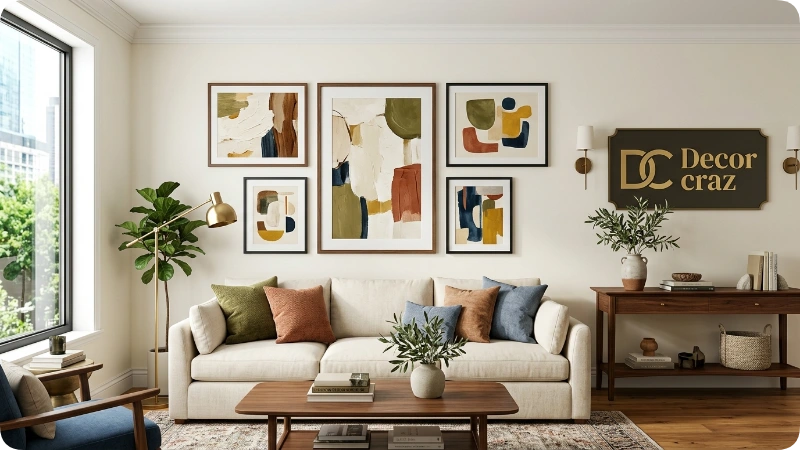
Once you know which wall decor family fits your room, proportion becomes the next decision.
Above a sofa
Treat the artwork or gallery wall as one visual unit. Around two thirds of the sofa width is a useful starting point for the total arrangement.
Above a console
The same principle applies, but the exact width can change depending on the console’s depth and surrounding architecture.
On an open wall
Centering artwork around 57–60 inches from the floor is a useful starting guideline, rather than automatically placing it high enough to fill the wall.
Above furniture
A common starting range is approximately 6–10 inches between the furniture and the bottom of the artwork. Treat this as a proportional guideline rather than a fixed law; unusually tall furniture, low sofas, or very large artwork may require adjustment.
In a small living room
Favor fewer, stronger elements. One large artwork or mirror can establish a clearer focal point than several tiny pieces scattered around the room.
Common Living Room Wall Decor Mistakes to Avoid
Choosing art before measuring the wall
Measure the furniture and wall first. A beautiful piece can still look wrong when its proportions are too small or too large.
Hanging artwork too high
A large gap between the sofa and artwork can disconnect the two elements. Bring the composition closer to the furniture when appropriate.
Filling every empty area
Not every blank patch needs decoration. Negative space helps important pieces remain visually clear.
Mixing too many unrelated styles
A gallery can contain different subjects, but use something consistent such as color, frame treatment, scale, or theme to make the collection feel deliberate.
Using a mirror without checking its reflection
A mirror doubles whatever it faces. Place it where the reflection contributes something useful.
Using renter hardware without checking specifications
Adhesive products have specific weight, surface, and installation requirements. Follow the manufacturer’s instructions instead of assuming one product works for every wall.
Final Checklist for Decorating Your Living Room Walls

Before drilling, painting, or buying a large piece, check:
- Purpose: What problem is the wall solving?
- Anchor: What furniture or architectural feature should the decor relate to?
- Scale: Is the overall arrangement large enough for the wall?
- Height: Does it connect comfortably with the furniture below?
- Color: Does it relate to the existing room without matching everything exactly?
- Reflection: If using a mirror, what will it reflect?
- Commitment: Do you want a temporary, flexible, or permanent solution?
- Safety: Is the mounting method appropriate for the item’s weight and wall type?
- Editing: Would removing one element make the composition clearer?
The goal is not to decorate every wall. It is to give the walls that matter a clear role.
FAQ
How do I decorate a large blank living room wall?
Start with the wall’s width and the furniture beneath it. Oversized artwork, a properly scaled gallery wall, long shelving, built ins, or an architectural treatment can provide enough visual weight without scattering small decorations across the wall. Large wall guidance from The Spruce similarly identifies oversized art, mirrors, built ins, shelving, wallpaper, and textured treatments as practical solution families.
How high should wall art be above a sofa?
A useful starting point is to leave roughly 6–10 inches between the sofa and the bottom of the artwork, then adjust for the sofa height, artwork size, and overall composition.
Is one large piece of art better than a gallery wall?
Neither is universally better. One large piece creates a simpler focal point and is easier to position, while a gallery wall gives you more flexibility to combine different artwork and personal pieces. The choice should depend on the wall’s proportions and how much visual variety you want.
Conclusion
Living room wall decor can completely change how a space feels, but the best results come from choosing pieces that fit the wall, furniture, and overall room layout. Start by deciding what the wall needs a strong focal point, added texture, storage, reflection, or simply more personality.
Oversized artwork, gallery walls, mirrors, shelves, textured decor, TV wall arrangements, and architectural treatments each offer a different way to solve the space. Pay close attention to scale and placement so your decor feels connected to the furniture instead of floating above it.
If you rent or frequently change your style, choose flexible and low commitment options. Most importantly, avoid decorating every empty area. A well planned focal point with enough breathing room can make your living room feel more balanced, personal, and visually complete.

I am Claudia Winkle, a passionate Name Researcher and Content Writer at decorcraz.com. I enjoy exploring the meanings, origins, history, and cultural significance behind names from around the world. Through carefully researched and engaging articles, I help readers discover unique names, understand their stories, and find meaningful naming inspiration for every occasion. My goal is to make name research simple, interesting, and useful for readers looking for the perfect name.